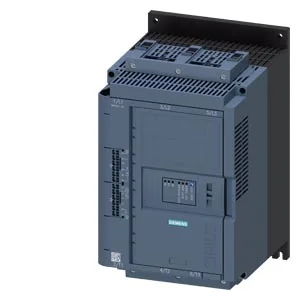
What this soft starter does in the panel
The Siemens SIRIUS 3RW5226-3AC14 is a hybrid soft starter that ramps three-phase induction motors up and down, reducing mechanical shock and inrush current on start. It carries a minimum setting of 32 A and is rated for a supply voltage of 200 to 480 V. The default Trip Class is 10A, with selectable 10E or 20E per IEC 60947-4-2, which governs how long the unit can sustain an overload before tripping — Class 10A is the standard for normal-starting loads like pumps and fans, while Class 20E buys extra ride-through for high-inertia starts. Mounting is screw-fixing on a vertical surface, with the unit rotatable ±90° and tiltable ±22.5° front-to-back, so it fits into tight panel layouts without forcing a specific orientation. The enclosure dimensions are 306 mm high, 185 mm wide, and 203 mm deep — size it into the gland-plate area before committing the backplate layout. Clearance requirements: 100 mm above, 75 mm below, 10 mm forward, 5 mm at the sides, and 0 mm backward.
Fieldbus and control — what talks to the PLC
This soft starter speaks multiple fieldbuses natively: PROFIBUS, PROFINET standard with PROFIenergy support, Modbus RTU, Modbus TCP, and EtherNet/IP. That covers most common automation networks without an external gateway — handy when you're standardizing one part number across sites with different PLC brands. The analog output is configurable as 4-20 mA or 0-10 V, settable via the High Feature HMI parameterization. Remote reset is done by cycling the control supply voltage, and an auto-reset function is built in. For fault tracking, an error logbook is available but requires a special accessory. Soft torque and pump ramp-down features are included — these reduce pressure surges in pumping systems and mechanical wear on conveyors. Torque control is not available, so this is a voltage-ramp soft starter, not a true torque-controlling unit.
Approvals include CE, UL, and CSA, covering installations in North America and Europe without separate certification runs.