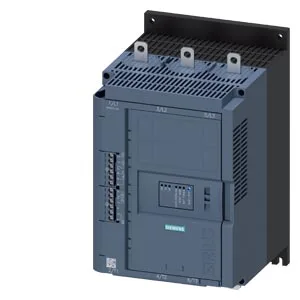
Panel fit and dimensions for a tight enclosure
The 3RW5236-6TC04 measures 306 mm high, 185 mm wide, and 203 mm deep — a substantial footprint that demands careful gland-plate planning and DIN-rail clearance. The screw-fixing fastening method means it bolts directly to the backplate, not a snap-on rail, so the mounting holes must be laid out before the panel is punched. Clearance requirements are tight: 100 mm above, 75 mm below, 10 mm forward, and 5 mm at the sides. No clearance is needed behind the unit. This asymmetry matters when stacking multiple soft starters in a row — the vertical gaps eat into the usable panel height faster than the horizontal ones. Mounting position is forgiving: the unit accepts a vertical mounting surface with ±90° rotation and ±22.5° tilt forward or backward. That lets you angle it away from a hot busbar or toward a cooling duct without a custom bracket.
Rated current floor and trip class — what drives the motor protection
Minimum rated current is 81 A. That is the floor for the smallest settable motor full-load current (Ie) the soft starter can protect — anything below 81 A and the internal overload curve cannot be calibrated low enough. For a 50 hp motor at 460 V (roughly 65 A FLA), this starter is oversized; you would need a lower-rated unit in the same SIRIUS family. Trip class defaults to CLASS 10A, with selectable CLASS 10E and CLASS 20E per IEC 60947-4-2. The 200-480 V rated voltage range covers 208 V, 240 V, 277 V, 400 V, and 480 V line supplies — common across North American and European industrial panels. No 575 V or 600 V coverage here; those need the higher-voltage variant in the series.
Fieldbus suite for the controls layer
This soft starter carries PROFIBUS, Modbus RTU, Modbus TCP, EtherNet/IP, and PROFINET. That is a full industrial Ethernet and fieldbus portfolio — no gateway needed for most PLC racks. PROFIenergy is supported via the PROFINET standard communication module, letting the drive coordinate energy-saving idle states with the rest of the line. The 24 V DC control supply powers the electronics and the communication module; it is separate from the motor power circuit, so the bus stays alive even when the main contactor is open. Remote reset is available by cycling the control supply voltage — useful for unattended restart after a fault.
Active lifecycle and regulatory acceptance
CE marking, UL approval, and CSA approval are all confirmed. That covers the three major industrial certification regimes: European CE for the Machinery Directive, UL for US panel acceptance, and CSA for Canadian installations. Pollution degree 3 per IEC 60947-4-2 means it is rated for conductive pollution in industrial atmospheres — no special enclosure needed for most factory floors.
Thermal limits and shock tolerance in a mill environment
In a steel mill where the cabinet near the rolls can hit 50 °C, you must derate the continuous output current per the curve in the manual — the nameplate rating applies only up to 40 °C. This unit takes the radiant heat better than a commercial-temp drive, but the derating is real and must be calculated. Shock resistance is 15 g for 11 ms, dropping to 12 g for 11 ms if potential contact lifting is a concern. That is robust enough for a vibrating conveyor line or a crusher feeder, but a direct hit from a drop hammer or a press might exceed the rating — mount it on a vibration-dampening bracket if the shock source is within a few meters.