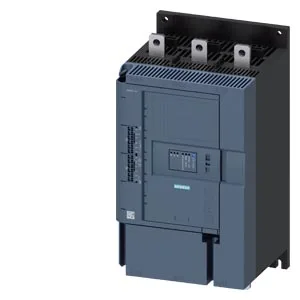
Rated current and trip class — what governs the motor start
The 3RW5244-2AC15 is rated for a minimum setting of 100 A with a trip class selectable as CLASS 10A (default), 10E, or 20E per IEC 60947-4-2. For a motor that must accelerate a high-inertia load — a centrifuge or a large fan — the 20E setting gives the extra time before the soft starter trips on overload, while 10A is the standard for most pump and conveyor starts. The operating voltage range is 200... 600 V, covering the common 208 V, 400 V, and 480 V three-phase networks without a tap change.
Fieldbus and analog output — integration into the control network
This soft starter carries PROFIBUS, Modbus RTU, Modbus TCP, EtherNet/IP, and PROFINET standard communication, plus PROFIenergy support when used with the PROFINET communication module. That means it drops into a Siemens S7 environment or a Rockwell ControlLogix rack without a protocol gateway. The analog output is configurable as 4... 20 mA (default) or 0... 10 V, parameterizable through the High Feature HMI. This gives the control system a real-time current or torque signal for monitoring or closed-loop control.
Mounting and clearance — panel layout constraints
The unit measures 393 mm high x 210 mm wide x 203 mm deep and is fastened by screw fixing. The mounting position allows a vertical surface with +/-90° rotation and +/-22.5° tilt front-to-back, so it can be oriented to fit tight enclosures. Clearance requirements: 100 mm upwards, 10 mm forwards, 0 mm backwards, 75 mm downwards, and 5 mm at the side. The zero backward clearance means the unit can sit flush against the back panel, saving depth in shallow enclosures.
Operating temperature and derating — thermal budget in the panel
The ambient operating range is -25... +60 °C during operation, but derating applies at 40 °C or above. In a panel with other heat sources — drives, transformers, braking resistors — the soft starter's continuous current must be reduced per the derating curve, or the enclosure must be ventilated. Shock resistance is 15 g / 11 ms, with potential contact lifting at 12 g / 11 ms. This matters for applications mounted on vibrating machinery or in mobile equipment.
Approvals include CE marking, UL approval, and CSA approval, covering installations in North America and Europe without additional certification paperwork.