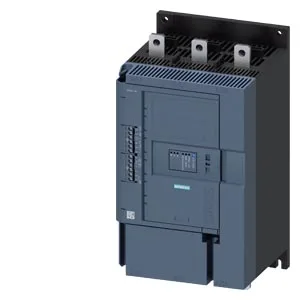
Motor fit — the three specs that decide it
The 3RW5245-6TC14 is a SIRIUS soft starter rated for a minimum current of 135 A at an operating voltage of 200-480 V. That 135 A floor is the key number for motor matching — it sets the smallest motor this unit can soft-start without dropping below the minimum load threshold of 15% relative to the smallest settable Ie. Trip Class is selectable as CLASS 10A (default), 10E, or 20E per IEC 60947-4-2. Class 10A is the standard for standard-start applications; Class 20E gives you a longer thermal memory for high-inertia loads where the start takes longer. Pick the class that matches your motor's acceleration time and the upstream protection coordination.
Fieldbus and control — what connects where
This soft starter ships with onboard PROFIBUS, Modbus RTU, Modbus TCP, EtherNet/IP, and PROFINET standard communication. That means it drops into most common industrial networks without an extra gateway module — one part number covers the fieldbus slice. PROFIenergy is supported in connection with the PROFINET Standard communication module, which lets the drive participate in energy management profiles during idle periods. The unit also supports firmware updates in the field. Control features include Soft Torque for gentle acceleration, Pump Ramp Down for controlled deceleration in pumping applications, auto-RESET, and Remote Reset by cycling the control supply voltage. No analog output or torque control on this variant.
Mounting and clearances — panel fit
Fastening method is screw fixing, with a vertical mounting surface that can be rotated ±90° or tilted ±22.5° front-to-back. Dimensions are 393 mm height, 210 mm width, 203 mm depth — that's a substantial footprint, so check your gland plate and DIN-rail backplane before committing. Required clearances: 100 mm upwards, 10 mm forwards, 0 mm backwards, 75 mm downwards, and 5 mm at the sides. The zero backwards clearance is notable — you can mount it flush against the back panel, which saves depth in a tight enclosure.
Environmental and approvals
Shock resistance is 15 g / 11 ms, dropping to 12 g / 11 ms with potential contact lifting — relevant if this sits near a press or conveyor with repetitive impacts. Approvals include UL, CSA, and CE marking — covers North American and European installations without additional certification paperwork.