160 A rated current — what it means for the motor
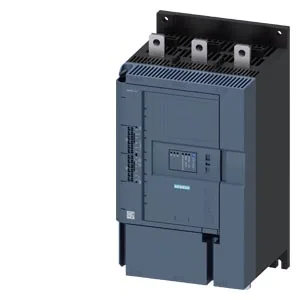
The 3RW5246-2AC05 is a SIRIUS soft starter rated for a minimum motor current of 160 A. That's the smallest settable Ie — the actual motor FLA you program into the unit must be at or above this floor. The voltage range covers 200 to 600 V AC, so it fits common low-voltage networks from 208 V to 480 V and up to 600 V Canadian-style supplies. Trip class is selectable: Class 10A (default), 10E, or 20E per IEC 60947-4-2. For a pump or fan with a long deceleration ramp, Class 20E gives you more thermal headroom during the start; for a conveyor that needs a quick cut-out on overload, stick with 10A. The unit also supports a soft torque ramp and pump ramp-down, so it's well suited for fluid-handling applications where water hammer is a concern.
Fieldbus and control — which networks it speaks
This soft starter comes with onboard PROFIBUS, Modbus RTU, Modbus TCP, EtherNet/IP, and PROFINET — that's essentially the full industrial Ethernet and fieldbus suite in one unit. It also supports PROFIenergy for energy management when used with the PROFINET communication module. The analog output is configurable as 4-20 mA or 0-10 V, letting you feed a motor current signal to a PLC or SCADA without an extra transducer. A remote reset is possible by cycling the 24 V control supply, and the unit supports auto-reset — useful for unattended pumping stations where a manual reset trip would require a site visit. The firmware can be updated in the field, which matters for long-life installations where you might need to patch for new network profiles.
Mounting and clearance — panel fit
Dimensions are 393 mm height, 210 mm width, 203 mm depth. Mounting is by screw fixing — no DIN-rail clip, so budget for four M6 bolts into a backplate. Clearance requirements: 100 mm above the unit, 10 mm in front, 0 mm behind, 75 mm below, and 5 mm on each side. The 100 mm top clearance is the one that catches people out — skimping there blocks airflow through the heatsink fins. If the panel ambient hits 50 °C, you'll need to reduce the continuous current — the exact curve is in the manual. Shock resistance is 15 g for 11 ms, which is typical for industrial floor-mounted gear but not for mobile or marine applications without additional damping.