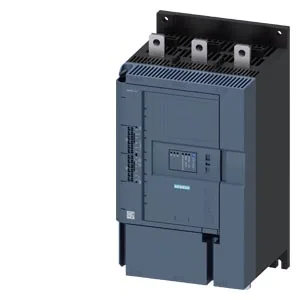
Sizing this soft starter for the motor line
The 3RW5248-2AC14 is a SIRIUS hybrid switching device rated for a minimum motor current of 240 A at a rated voltage of 200-480 V — this sets the floor for the motor FLA it can start, not the ceiling; the actual continuous current capacity depends on the trip class selected and ambient derating. Trip class is configurable as CLASS 10A (default), 10E, or 20E per IEC 60947-4-2, which governs how long the starter can sustain inrush current during acceleration — 10A allows 10 seconds at 7× FLA, 20E allows 20 seconds at the same multiple, so match the class to the load's acceleration time: conveyors and pumps typically run 10A; high-inertia fans or centrifuges may need 20E.
Fieldbus and control wiring
This unit supports PROFIBUS, Modbus RTU, Modbus TCP, EtherNet/IP, and PROFINET standard — the fieldbus interface is onboard for PROFIBUS and Modbus RTU; Modbus TCP, EtherNet/IP, and PROFINET require the optional communication module, so confirm the BOM includes the correct module if the network is Ethernet-based. Analog output is 4-20 mA (default) or 0-10 V (parameterizable with the High Feature HMI), giving a speed or current signal back to the PLC — useful for monitoring motor load without a separate transducer.
Mounting and clearance for panel layout
Fastening method is screw fixing — no DIN-rail clip; the unit bolts directly to the back panel. Dimensions are 203 mm depth, 210 mm width, 393 mm height, so allocate a cutout or mounting plate area at least 210×393 mm plus clearance. Required clearance distances: 100 mm upwards, 10 mm forwards, 0 mm backwards, 75 mm downwards, and 5 mm at the side — the zero backward clearance means it can sit flush against the back panel or a busbar, but the upward gap is critical for heat dissipation from the power stack. Mounting position allows vertical surface with ±90° rotation and ±22.5° tilt forward/back, giving flexibility in tight enclosures — but the derating note above 40 °C applies regardless of orientation.
Compliance and documentation for cross-border shipment
CE marking, UL approval, and CSA approval are all confirmed on this variant — the UL and CSA marks cover North American installations; CE covers European machinery directive compliance. Shock resistance is 15 g / 11 ms, with potential contact lifting noted from 12 g / 11 ms — this matters for transport or installation in high-vibration environments like mobile equipment or near large contactors.