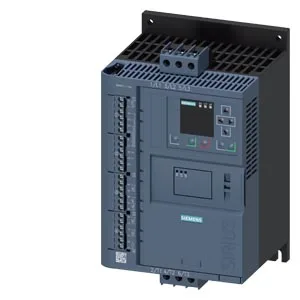
Active production, ATEX-certified — what that means for procurement
The 3RW5515-1HA05 carries a current lifecycle stage — no end-of-life notice, no last-time-buy window to manage. ATEX and IECEx certification (both Yes) qualifies this soft starter for installation in Zone 1 or Zone 2 explosive atmospheres — a mandatory requirement for chemical, pharmaceutical, and oil-and-gas lines. This is not a general-purpose unit retrofitted with an enclosure; the base device carries the marking.
Trip class and motor protection — the IEC 60947-4-2 curve
Trip class is selectable: CLASS 10A (default), 10E, 20E, or 30E per IEC 60947-4-2. CLASS 10A clears a locked-rotor condition within 10 seconds — appropriate for standard induction motors;. The voltage ramp function, combined with a breakaway pulse, lets the starter deliver a high-torque burst to break sticky loads (conveyors, crushers) then ramp smoothly to full speed. Pump ramp down reduces water hammer on deceleration — a feature that saves mechanical wear on valves and piping. Torque control and DC braking are both present — torque control maintains acceleration linearity under varying load; DC braking stops the motor shaft quickly without a mechanical brake.
Panel fit and clearance — the 170 x 275 x 152 mm envelope
Width 170 mm, height 275 mm, depth 152 mm. Minimum clearance above the unit is 100 mm, below 75 mm, and 10 mm forward — backwards clearance is 0 mm, meaning the back of the unit can sit flush against the panel backplate. Side clearance is 5 mm.
Fieldbus and analog feedback — integration into the control system
PROFIBUS and Modbus TCP are both supported — no Modbus RTU. PROFINET is not listed, but PROFIenergy is available in connection with PROFINET Standard and High-Feature communication modules. This means the starter can participate in energy-management profiles on a PROFINET network. Analog output configurable as 4…20 mA (default) or 0…10 V — feeds motor current, voltage, or power data to a PLC analog input or SCADA system. Accuracy class 5 per IEC 61557-12, which corresponds to ±5% of reading — acceptable for monitoring but not for revenue metering. Event list, error logbook, and trace function are built in — useful for commissioning fault-finding and post-event analysis without an external data logger.