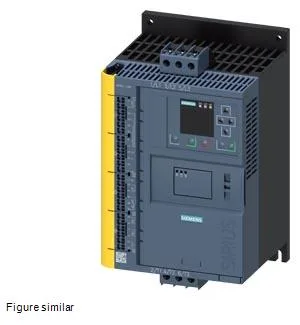
ATEX-certified soft starter for hazardous-area motor control
The Siemens 3RW5515-3HF04 is a soft starter with both ATEX and IECEx certification, meaning it's approved for installation in explosive atmospheres where gas or dust hazards are present. This is the headline differentiator — most soft starters in this class lack hazardous-area approvals, so if your line runs in a Zone 1/2 or Zone 21/22 environment, this unit saves you the external isolation barrier. Rated voltage spans 200 to 480 V AC, covering common global industrial supplies from 208 V to 480 V without a tap-change.
Fieldbus and control integration
The 3RW5515-3HF04 carries PROFIBUS, Modbus RTU, Modbus TCP, and EtherNet/IP on the same hardware — no separate communication module needed for these protocols. That's a panel-space saver: one slot, one wiring bundle, and the fieldbus selection is set via parameter, not a physical card swap. Analog output is field-configurable as 4–20 mA (default) or 0–10 V, giving the PLC a real-time motor current or torque signal without an external transducer. The accuracy class is 5 per IEC 61557-12, which is sufficient for process monitoring but not for revenue-grade metering. PROFIenergy support is present when used with PROFINET communication modules — this allows the soft starter to participate in coordinated energy-saving pauses during production breaks, a feature increasingly specified in automotive and battery manufacturing lines.
Motor control features for demanding starts
Beyond basic voltage ramp starting, this unit includes DC braking for rapid stopping of high-inertia loads, pump ramp down to prevent water hammer in pumping stations, torque control for gentle acceleration of conveyors, and a breakaway pulse to crack stuck loads before the ramp begins. These are not gimmicks — they solve real field problems that cause nuisance trips or mechanical wear. Motor heating protection uses a thermal model that tracks the motor's temperature rise during start and run cycles, enabling the soft starter to trip before the motor insulation degrades. The service factor is 1.15, meaning the overload curve allows 15% continuous overcurrent above nameplate — common for pump and fan applications where the motor is sized with margin. The safe state is open load circuit, and the unit has one fail-safe channel (with fail-safe = 1). This means when the safety circuit is triggered, the output contacts open and remove power from the motor — no half-voltage or trickle current. The B10d value is 1,588,000 cycles, which is the number of operations before 10% of a population fails dangerously; for a soft starter this is a high figure, indicating the safety relay path is robust.
Panel mounting and clearance requirements
Dimensions are 170 mm wide, 275 mm high, 152 mm deep — this is a compact footprint for a soft starter in this power class, but it needs specific clearances: 100 mm above, 75 mm below, 10 mm forward, 5 mm at the sides, and 0 mm backward (wall-mountable). The 0 mm rear clearance means it can sit flush against a back panel, saving depth in shallow enclosures. There is no screw terminal — the connection type is spring-clamp or cage-clamp, which means faster wiring but requires a specific screwdriver blade and cannot accept ferruled stranded wire without the ferrule being the correct length.
Diagnostics and lifecycle management
The unit logs events and errors in an internal logbook, and has a trace function that captures the last few seconds of operation before a trip — invaluable for diagnosing intermittent faults on a motor that starts fine cold but trips when hot. Firmware updates are field-loadable, so new features or bug fixes don't require a hardware swap. Auto-reset and remote reset are both supported, allowing the soft starter to restart automatically after a cleared fault — useful for unmanned pumping stations or remote conveyor drives. The reset can be triggered via the fieldbus or a hardwired remote button. Approvals include CE, UL, and CSA — covering European and North American installations. The ATEX and IECEx marks are the key ones for hazardous locations; the UL/CSA listing means it's accepted in US and Canadian panels without additional agency review.