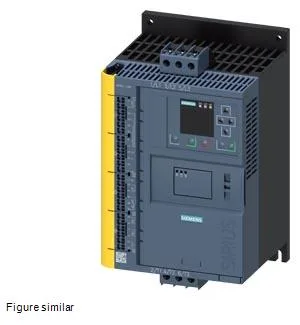
What this soft starter delivers that a contactor can't
The 3RW5515-3HF14: A contactor slams the motor across the line — this soft starter ramps voltage from 0 to the line using a voltage ramp and torque control, so the pump or conveyor accelerates without the mechanical shock or inrush that trips upstream breakers. Trip class is selectable: CLASS 10A / 10E (default) / 20E / 30E per IEC 60947-4-2. CLASS 10A suits high-inertia loads that need a fast thermal cutout; CLASS 30E gives more headroom for long acceleration times on fans or centrifuges. The default 10E covers most general-purpose starts. Rated voltage 200...480 V covers 208 V, 230 V, 400 V, and 480 V nominal systems — common in North American and European industrial panels. No transformer needed between the supply and the soft starter.
Hazardous-location and global compliance — ATEX, IECEx, UL, CSA
ATEX and IECEx certified — the soft starter can be installed in Zone 2 or Zone 22 areas where explosive gas or dust atmospheres may occur. The safe state is open load circuit, meaning the output contacts open on fault, removing power from the motor in a hazardous zone. UL and CSA approvals cover North American installations; CE marking covers the European market. The B10d value of 1,588,000 supports safety function assessments per IEC 61508 — useful when the soft starter is part of a safety-related stop circuit.
Fieldbus and diagnostics — PROFIBUS, Modbus, EtherNet/IP, PROFIenergy
Onboard PROFIBUS, Modbus RTU, Modbus TCP, and EtherNet/IP — no external gateway needed for most PLC architectures. PROFIenergy allows the soft starter to participate in energy-management profiles when paired with a PROFINET communication module. Event list, error logbook, and trace function give the commissioning engineer a record of starts, trips, and parameter changes — useful for FAT/SAT sign-off and later fault analysis. Analog output configurable as 4...20 mA or 0...10 V — feed motor current or torque to a PLC analog input or a local panel meter without an external transducer.
Mounting and panel integration — clearances and wiring
Dimensions: 152 mm deep, 170 mm wide, 275 mm high. Clearance requirements: 100 mm above, 10 mm in front, 0 mm behind, 75 mm below, 5 mm at the sides — the zero rear clearance means it can sit against the back panel, saving depth. Solid conductor terminations: 2x (1.0...2.5 mm²) and 2x (2.5...10 mm²) — the larger cross-section handles the power wiring; the smaller pair suits control or auxiliary circuits. Screw terminals are not fitted — the unit uses spring-cage or push-in clamps.
Motor protection and process features — DC braking, pump ramp down, motor heating
DC braking stops the motor faster than coast-to-rest — useful for conveyors that need to hold position after stop. Pump ramp down reduces the voltage gradually to eliminate water hammer in pump systems. Motor heating applies a low DC current to the motor windings when the soft starter is idle — prevents condensation in motors that sit in humid environments between runs. Auto-reset and remote reset allow the soft starter to restart after a fault without a manual button press. Service factor 1.15 — the soft starter can handle a 15 % continuous overload above the motor FLA without tripping, matching typical NEMA motor service factors.