Voltage range and trip-class flexibility
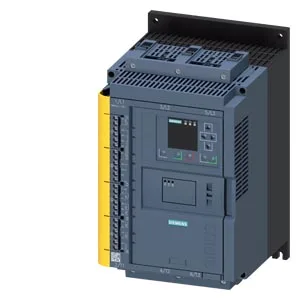
The 3RW5525-1HF04: Rated 200... 480 V, covering the common low-voltage motor bus without an autotransformer tap change. The trip class defaults to CLASS 10A / 10E per IEC 60947-4-2, with selectable 20E or 30E for high-inertia loads that need a longer acceleration ramp. The voltage ramp and torque control features let you dial in the start profile — breakaway pulse for stuck conveyors, pump ramp down to eliminate water hammer on stop. This is a soft starter that handles both normal and high-inertia starts from one unit.
Fieldbus and analog interface onboard
Comes with Modbus RTU as standard. PROFIBUS, Modbus TCP, and EtherNet/IP are also listed — pick the protocol that matches your controller without an add-on module. The analog output defaults to 4... 20 mA and can be switched to 0... 10 V, useful for feeding a local meter or PLC analog card. PROFIenergy support (with PROFINET communication modules) lets the starter participate in energy-management shutoff sequences during idle periods. The trace function and event log help pin down start-fault root cause without a separate data logger.
ATEX and hazardous-area deployment
ATEX and IECEx certified — this unit is listed for use in explosive atmospheres when paired with an appropriate motor and enclosure. The safe state on trip is open load circuit, which removes power from the motor terminals in a fault condition, a requirement for gas-group installations. UL and CSA approvals cover North American panel builds. The screw-terminal power connections are the standard choice for field wiring in both IEC and NEC installations.
Panel integration and cooling clearances
Width 185 mm, height 306 mm, depth 203 mm — fits a standard 600 mm deep enclosure with room for the incoming cable bend radius. Minimum clearance: 100 mm above, 75 mm below, 10 mm front, 5 mm sides, and 0 mm back. That 100 mm upward gap is critical for hot-air convection; stacking units tighter will derate the continuous current. The DC braking function allows controlled deceleration on high-inertia loads without a separate braking resistor. Auto-reset and remote reset let the starter re-start after a cleared fault without an operator walking to the panel — useful for remote pumping stations.