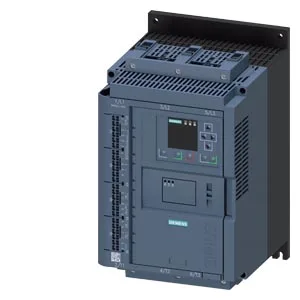
ATEX-certified soft starter for hazardous-area motor control
The Siemens 3RW5525-3HA04 is a SIRIUS soft starter carrying ATEX and IECEx certification, meaning it is approved for starting three-phase induction motors in potentially explosive atmospheres — a spec that gates the part for Zone 1/21 or Zone 2/22 installations where a standard soft starter would not be accepted. The rated voltage spans 200 to 480 V, covering the common low-voltage networks worldwide (208 V, 230 V, 400 V, 480 V) without needing a separate autotransformer tap. Trip class is field-selectable among CLASS 10A, 10E (default), 20E, and 30E per IEC 60947-4-2. CLASS 30E allows a longer ramp for high-inertia loads like centrifuges or large fans. The default 10E is a balanced choice for most pump and conveyor applications. In a non-air-conditioned panel near a furnace or compressor, plan for the thermal curve: full rated current only up to 40 °C; above that, reduce the motor FLA setting proportionally. The unit measures 306 mm high × 185 mm wide × 203 mm deep, with 100 mm clearance above and 75 mm below for airflow — factor that into the enclosure layout.
Fieldbus and control features for integrated lines
This soft starter supports PROFIBUS, Modbus RTU, Modbus TCP, and EtherNet/IP natively — no separate gateway module needed. That means it drops into a Siemens S7-1500 PROFINET line or a Rockwell ControlLogix EtherNet/IP cell with the same hardware. PROFIenergy is available when paired with PROFINET High-Feature communication modules, allowing the drive to shed standby power during production pauses. Analog output is configurable as 4-20 mA (default) or 0-10 V, giving a proportional motor current or load signal back to the PLC or a local panel meter. Combined braking, DC braking, voltage ramp, pump ramp down, torque control, and a breakaway pulse are all built in — no external contactor or resistor pack required for most soft-start/soft-stop profiles. The service factor is 1.15, so the starter can handle a 15 % continuous overload above the motor nameplate without tripping. Event list, error logbook, and trace function are onboard for fault diagnosis. The unit logs the last several trip events with time stamps, which speeds up root-cause analysis on a line-down call. Firmware updates are field-loadable via the communication interface.