Trip class and motor protection — what the 10A/10E rating means
The 3RW5525-3HA16 ships with a default trip class of 10A/10E per IEC 60947-4-2, with field-selectable options up to 30E. Class 10A clears the start within 10 seconds at 6× FLA — this is the standard for most centrifugal pumps and fans where the load accelerates quickly. Class 20E or 30E buys you longer ramp time for high-inertia loads like crushers or centrifuges, but the soft starter's thermal model still protects the motor during the start.
Fieldbus and control integration — PROFIBUS, Modbus, EtherNet/IP
This unit supports PROFIBUS, Modbus RTU, Modbus TCP, and EtherNet/IP natively — no separate communication module required for most topologies. The PROFIBUS interface handles cyclic process data (actual current, status, faults) and acyclic parameter access for remote commissioning. Modbus TCP and EtherNet/IP share the same physical port; the protocol is auto-detected on link-up. PROFIenergy is supported when paired with a PROFINET communication module, allowing the soft starter to participate in coordinated energy-saving pauses during production gaps.
ATEX and IECEx — certified for explosive atmospheres
Both ATEX and IECEx certification are listed on this order code. That means the soft starter can be installed in Zone 1 or Zone 2 gas environments and Zone 21 or Zone 22 dust environments, provided the upstream protection and cable glands match the installation standard. The certification covers the enclosure as a whole — not just the power section — so the control terminals and fieldbus port are also within the certified boundary.
Panel fit — dimensions and clearances
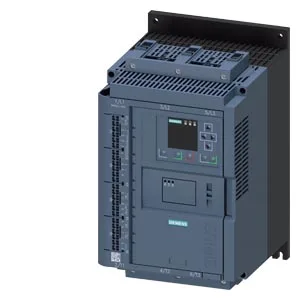
The enclosure measures 306 mm high, 185 mm wide, and 203 mm deep. Minimum clearance around the unit: 100 mm above, 75 mm below, 5 mm at the sides, 10 mm in front, and 0 mm behind. The zero rear clearance means it can sit flush against the back panel — useful when you're retrofitting into an existing enclosure where depth is tight.
Motor control features — voltage ramp, torque control, pump ramp down
The voltage ramp start is the standard soft-start method, but this unit also includes torque control for applications where a linear acceleration profile matters — conveyors with breakaway torque, for example. The pump ramp down feature extends the deceleration time to prevent water hammer in pumping systems. A breakaway pulse is available to kick the motor past static friction before the ramp begins. DC braking is built in — no external braking contactor needed for quick stops on high-inertia loads. The auto-reset and remote reset functions let the starter recover from a fault without a manual panel visit, which is useful for remote or unattended installations.
Diagnostics and data logging — event list, trace, error logbook
The event list and error logbook record the last several faults with timestamps — useful for diagnosing intermittent trips without sitting on site with a laptop. The trace function captures analog values (current, voltage, power factor) over a configurable window before and after a trigger event. A 4-20 mA or 0-10 V analog output is available for feeding motor current to a PLC or chart recorder. Firmware updates are field-loadable, so you can apply Siemens patches without swapping the unit. The parameter set has four slots, allowing quick changeover between motor profiles or application settings.
Compliance and approvals — UL, CSA, CE, accuracy class 5
UL and CSA approvals are listed, covering North American installations. CE marking covers the European low-voltage and EMC directives. The accuracy class is 5 per IEC 61557-12, meaning the current measurement is within ±5% of reading — adequate for motor protection and energy monitoring without a separate CT. The service factor is 1.15, so the unit can handle continuous overload up to 115% of rated current without tripping — matching the typical service factor of NEMA-design motors.