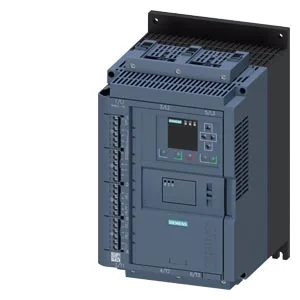
Motor starting profile and trip class selection
The 3RW5526-1HA04 operates on a 200-480 V supply and offers selectable trip classes: CLASS 10A / 10E (default) / 20E / 30E per IEC 60947-4-2. For a pump or conveyor with a normal start duration, the default 10E setting limits thermal stress on the motor windings. Switch to 20E or 30E only when the load inertia demands a longer acceleration ramp — like a centrifuge or a large fan — and verify the motor's thermal withstand curve allows it.
Fieldbus integration and analog feedback
Built-in Modbus RTU, Modbus TCP, and EtherNet/IP let this soft starter talk directly to a PLC without an external gateway. The analog output defaults to 4-20 mA but can be reconfigured to 0-10 V — useful for feeding motor current or torque to a legacy analog input card. The event list, error logbook, and trace function help narrow down start-fault causes during commissioning without needing a separate data logger.
Panel fit and clearance dimensions
The enclosure footprint is 185 mm wide, 306 mm tall, and 203 mm deep. Clearance requirements: 100 mm above, 75 mm below, 10 mm in front, 5 mm at the sides, and zero behind the unit. That zero-backwards clearance means it can sit flush against the back panel, saving depth in a shallow enclosure. Screw terminals are standard, so no special crimp tooling needed.
ATEX and IECEx certification for hazardous areas
This soft starter carries both ATEX and IECEx certification, meaning it's approved for installation in potentially explosive atmospheres per the EU directive and the international scheme. For a Zone 1 or Zone 2 motor start application — say a pump in a chemical processing area — the 3RW5526-1HA04 removes the need for a separate isolation interface. The CE marking and UL/CSA approvals cover the rest of the global regulatory map.
Application-specific starting features
The breakaway pulse delivers a short torque burst to break a stuck load free before the voltage ramp takes over — useful for a conveyor that sits overnight with product on the belt. Pump ramp down gradually reduces the voltage during stop to avoid water hammer in the piping. DC braking and combined braking give two ways to stop a rotating load faster than coast-down, which matters for a centrifuge or a saw that needs to halt before the guard opens.
Thermal management and derating
In a panel with other heat sources — drives, transformers, braking resistors — the internal temperature can easily hit 50 °C. Plan for reduced continuous current or forced ventilation if the soft starter shares a compartment with high-wattage gear.