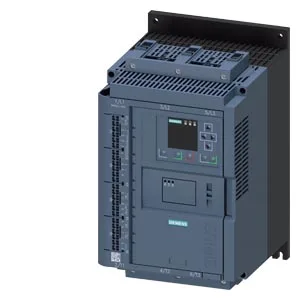
Hazardous-area motor starting — ATEX and IECEx certified
The 3RW5526-3HA14 carries ATEX and IECEx certification, meaning it can be installed in Zone 1 or Zone 2 gas atmospheres and Zone 21 or Zone 22 dust atmospheres when paired with an appropriately certified motor and enclosure. This is the primary differentiator from standard soft starters — the internal semiconductor junction and control electronics are designed to limit surface temperature and prevent arcing under fault conditions, meeting the requirements of the ATEX directive and IECEx scheme. The wide input window means the same unit handles 230 V, 400 V, and 480 V systems without a voltage-selector jumper — useful for OEMs shipping to multiple regions.
Trip class and motor protection flexibility
Selectable trip classes — CLASS 10A, 10E (default), 20E, or 30E per IEC 60947-4-2 — let you match the thermal overload curve to the load. Class 10A is for standard-start pumps and fans; Class 30E accommodates high-inertia loads like centrifuges or crushers where the start time exceeds 20 seconds. The default 10E setting covers most general-purpose motor starts without parameter changes out of the box. Accuracy Class 5 per IEC 61557-12 means the internal current measurement and motor protection algorithms are within 5% of reading — sufficient for overload protection and basic energy monitoring without an external CT. The service factor of 1.15 allows continuous operation at 115% of rated current, matching NEMA MG-1 motor service factors.
Fieldbus integration and control options
Built-in Modbus RTU (RS485) and Modbus TCP (Ethernet) ports, plus EtherNet/IP and PROFIBUS support, mean the starter connects directly to most PLC networks without an external gateway. The PROFIBUS interface is on-board — no separate communication module to order. For Siemens S7-1500 or S7-1200 controllers, the Modbus TCP link uses standard function blocks; the EtherNet/IP interface integrates with Rockwell ControlLogix via the standard EDS file. PROFIenergy profile support (when paired with a PROFINET communication module) enables energy-saving pauses during production breaks — the starter shuts down the motor and restarts on command without a full power cycle. The event list and error logbook store the last 20 fault events with timestamps, useful for diagnosing intermittent trips without a continuous PC connection.
Panel layout and clearance requirements
Minimum clearance around the unit: 100 mm above, 75 mm below, 10 mm in front, 5 mm at the sides, and 0 mm behind. The 100 mm upward clearance is critical for natural convection cooling — stacking units closer than that derates the continuous current rating. The 5 mm side clearance is tight enough for side-by-side mounting in a 600 mm wide enclosure. Screw terminals are not used — the unit has spring-cage or ring-lug connections (confirm the termination type from the product drawing). The absence of screw terminals speeds wiring but requires a specific screwdriver for the spring release.
Advanced starting and stopping features
Voltage ramp start, torque control, and breakaway pulse give three ways to handle different load profiles. The breakaway pulse delivers a short high-torque burst to break static friction on conveyors or mixers before the voltage ramp takes over — prevents the 'stall then slam' start. Pump ramp down gradually reduces voltage during stop to eliminate water hammer in pipeline systems. DC braking injects DC into the motor windings for a controlled stop without a mechanical brake. Analog output configurable as 4-20 mA or 0-10 V provides motor current, power, or torque feedback to a PLC analog input — useful for remote monitoring without a fieldbus connection. The auto-reset and remote reset functions allow the starter to restart after a fault without a panel visit, provided the fault condition has cleared.
Active production — sourcing and compliance
CE marking for European markets, UL and CSA approvals for North America — the unit carries the required safety certifications for installation in IEC and NEC jurisdictions. The ATEX and IECEx certifications are listed on the nameplate, so the inspection authority can verify compliance without separate documentation.