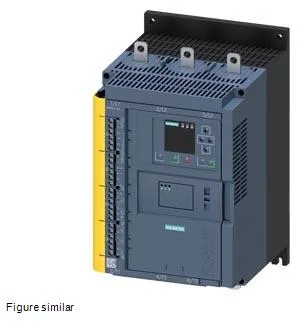
ATEX-certified soft starter for hazardous-area motor starting
The Siemens 3RW5535-6HF04 is a soft starter carrying both ATEX and IECEx certification, meaning it can be installed in Zone 1 or Zone 2 gas atmospheres and Zone 21 or Zone 22 dust atmospheres per the ATEX directive. This is not a standard soft starter — the ATEX mark tells you the internal components and enclosure are designed to prevent an ignition source in a defined hazardous area. Pair it with an ATEX-rated motor and the installation meets the full equipment directive for explosive environments. Rated for 200 to 480 V AC, this unit covers the common low-voltage industrial supply range across Europe, North America, and much of Asia. The voltage tolerance means it will handle a 400 V 50 Hz line or a 480 V 60 Hz line without derating — one part number for multi-voltage plants.
Trip class flexibility — match the load, not the rule
The 3RW5535-6HF04 offers selectable trip classes CLASS 10A / 10E (default) / 20E / 30E per IEC 60947-4-2. Class 10A is the standard for most motor starting — 10 seconds of overload at 7.2× rated current before tripping. The selector lets the commissioning engineer set the protection to the load without changing hardware. Trip class 10E is the default out of the box, which suits general-purpose pump and conveyor starting. Switching to 20E or 30E is a parameter change — no internal jumpers or resistor swaps. This is the same flexibility you get on a higher-end soft starter, packaged into a single frame.
Multi-protocol fieldbus and analog feedback
This soft starter supports Modbus RTU, Modbus TCP, EtherNet/IP, and PROFIBUS — four industrial Ethernet and serial protocols on one device. That means it drops into a Rockwell ControlLogix system over EtherNet/IP, a Siemens S7 over PROFIBUS, or a Modbus TCP SCADA without a gateway. The analog output can be configured for 4-20 mA or 0-10 V, feeding motor current or torque to a PLC analog input for trending. PROFIenergy support is available when paired with a PROFINET communication module — this allows the soft starter to participate in energy-saving pauses during production breaks, a feature for automated lines with coordinated shutdown sequences.
Advanced motor control and diagnostics
Voltage ramp provides a controlled acceleration profile — the output voltage rises from zero to full line over a set time, reducing mechanical shock on the driven load. Pump ramp down is a separate deceleration profile that reduces pressure surge in pipelines during stop. Torque control lets the starter regulate motor torque during start, useful for conveyors that must not jerk the belt. Breakaway pulse delivers a brief high-torque pulse to break static friction before the ramp begins — critical for stuck pumps or loaded conveyors. DC braking injects DC into the motor winding to stop it quickly without a mechanical brake. Motor heating can apply a low DC current to keep the motor warm in cold environments, preventing condensation inside the winding. The event list, error logbook, and trace function store the last several faults and operating data — useful for diagnosing intermittent trips without a laptop connected.
Physical integration and clearance
Dimensions are 185 mm wide, 306 mm high, and 203 mm deep. The screw terminal wiring accepts standard power and control conductors — no special crimp tooling. Clearance requirements: 100 mm above, 10 mm in front, 0 mm behind, 75 mm below, and 5 mm at the sides. These are the minimum free-air spaces for ventilation and wiring access; crowding them will raise internal temperature and reduce the starter's continuous current rating.
Safety and compliance
UL and CSA approvals cover North American installations — the soft starter carries the cULus mark for the US and Canada. ATEX and IECEx certifications are for explosive atmospheres. The fail-safe output provides a safe state of open load circuit, which means the output contacts open on a fault or power loss, stopping the motor. B10d value of 500,000 is the mean number of cycles until 10% of the population fails dangerously — relevant for safety function calculations per IEC 61508. Accuracy Class 5 per IEC 61557-12 means the current measurement error is within 5% of the reading — good enough for motor protection and trending, but not for revenue metering. Service factor 1.15 allows the starter to run at 115% of its rated continuous current without tripping, matching typical motor service factors.