What the ATEX and IECEx certifications mean for your installation
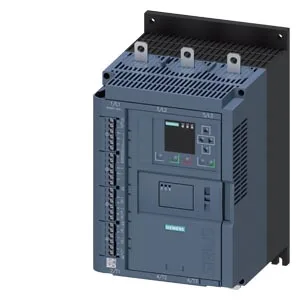
The 3RW5536-6HA06: This soft starter carries ATEX and IECEx certification, meaning it is approved for installation in potentially explosive atmospheres — not just the starter itself, but the motor branch circuit it controls. The ATEX and IECEx marks (both listed) cover the enclosure and the internal electronics, so the unit can be mounted in Zone 2 or Zone 22 areas without an additional purge or isolation barrier, provided the motor and cabling also meet the zone requirements.
Trip class selection — matching the start profile to the load
The 3RW5536-6HA06 offers selectable trip classes: CLASS 10A / 10E (default) / 20E / 30E, per IEC 60947-4-2. This means you can tune the thermal overload protection to the actual start time of the driven load — a centrifugal pump that starts in 5 seconds can run on 10A, while a high-inertia centrifuge needing 20 seconds to accelerate should be set to 20E or 30E to avoid nuisance tripping during start. The default 10E gives a balanced start for most standard industrial loads. The unit also includes DC braking, combined braking, and a breakaway pulse for loads that need a momentary torque spike to break free from static friction — useful on crushers, conveyors, or mixers where the material settles between starts.
Fieldbus integration and analog feedback
This soft starter supports Modbus RTU, Modbus TCP, EtherNet/IP, and PROFIBUS — four common industrial protocols — plus PROFINET with PROFIenergy for coordinated energy management in automated lines. The analog output can be configured for 4-20 mA or 0-10 V, giving the PLC a real-time current or torque signal for monitoring or closed-loop control. The onboard event list, error logbook, and trace function let you capture start profiles and fault sequences without an external data logger — useful for commissioning a new pump or diagnosing nuisance trips on a conveyor.
Mounting dimensions and clearance requirements
The unit measures 306 mm high, 185 mm wide, and 203 mm deep, and is fastened with screw fixing. For ventilation and wiring access, Siemens specifies 100 mm clearance above, 75 mm below, 10 mm forward, 5 mm to the side, and 0 mm backward — so plan the panel layout with these gaps to avoid derating or restricted airflow.
Operating temperature and derating
Rated for -25 to +60 °C ambient during operation, but Siemens explicitly notes derating is required at temperatures of 40 °C or above. If the panel ambient runs at 50 °C, expect a reduction in the continuous current rating — the exact derating curve should be applied from the product manual to avoid nuisance tripping on a warm production floor.
Compliance and approvals — CE, UL, CSA
CE marking confirms conformity with EU low-voltage and EMC directives; UL and CSA approvals cover North American installations. These three marks alone cover the majority of global industrial sites, reducing the need for separate local certifications.