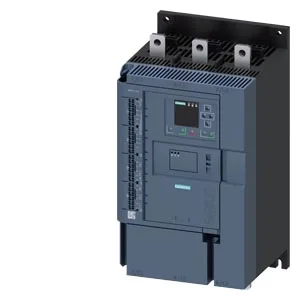
Active production, ATEX-rated — what that means for a mill environment
The 3RW5543-2HA16: Trip class selection is field-configurable: CLASS 10A (default), 10E, 20E, or 30E per IEC 60947-4-2. On a conveyor starting into a loaded belt, 20E or 30E buys the extra thermal budget to get past breakaway without nuisance tripping; 10A is the right call for a pump with a closed discharge valve start. The 1.15 service factor means the starter handles a motor running at 115 % nameplate continuously — relevant when a downstream mill stand pulls overload on a marginal pass.
Control voltage and fieldbus — what connects where
The unit ships with Modbus RTU, Modbus TCP, EtherNet/IP, and PROFIBUS onboard; PROFINET with PROFIenergy is available via the High-Feature communication module. For a line with mixed Siemens and Rockwell drives, the EtherNet/IP slice lets the starter sit on the same ring as the PowerFlex fleet without a protocol gateway. Analog output is jumper-configurable for 4-20 mA (default) or 0-10 V — feed motor current or torque to a PLC analog card or a chart recorder for pass-tracking. The torque control and pump ramp-down features are useful on a centrifuge or a high-head pump: the soft stop extends the deceleration to prevent water hammer, and the breakaway pulse (a short current spike at start) cracks a stuck impeller loose without slamming the line.
Clearances and panel fit
Physical envelope: 393 mm high, 210 mm wide, 203 mm deep. Minimum clearance requirements are 100 mm above, 75 mm below, 5 mm at the sides, 10 mm in front, 0 mm behind. That zero back clearance means the unit can sit flush against the back panel — useful when the gland plate is already dense. The dimensions and clearances are consistent with the 3RW55 frame size; no special sub-panel or offset bracket is needed for standard 800 mm wide enclosures.
Compliance documentation and traceability
CE marking, UL approval, and CSA approval are all confirmed on this order code. The ATEX and IECEx certificates cover the unit for explosive atmospheres — the specific certificate numbers are on the nameplate and should be cross-referenced against the site's hazardous-area register. No screw terminals on this variant (the power connections are likely cage-clamp or busbar); verify the lug type against the site wiring standard before the panel build.