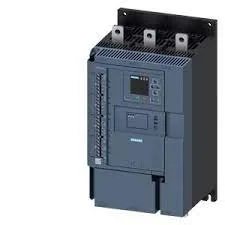
Trip class and motor protection profile
The 3RW5544-6HA04: Trip class is selectable: CLASS 10A / 10E (default) / 20E / 30E per IEC 60947-4-2. For a pump or conveyor start, Class 10A clears the start within 10 seconds at locked-rotor current — match this to the motor's acceleration time or the soft starter will trip on a normal start. The default 10E is the electronic equivalent; 20E and 30E extend the window for high-inertia loads. Accuracy Class 5 (per IEC 61557-12) means the current measurement uncertainty is within ±5 % of reading — adequate for overload protection but not for precision energy monitoring.
Mounting clearances and panel fit
The unit measures 393 mm high, 210 mm wide, 203 mm deep. Required free space around the enclosure: 100 mm above, 75 mm below, 10 mm in front, 5 mm at the sides, and 0 mm behind. For a panel builder, the 203 mm depth plus the 10 mm front clearance means the back panel to door clearance must be at least 213 mm — check this against the enclosure depth before laying out the backplate. Screw terminals are standard; no special tooling needed.
Control features and communication options
Built-in control functions include voltage ramp, torque control, breakaway pulse, pump ramp down, DC braking, and combined braking — all parameterizable via the onboard interface. Communication protocols supported: PROFIBUS, Modbus RTU, Modbus TCP, EtherNet/IP, and PROFIenergy (the latter requires a PROFINET High-Feature communication module). For a field service tech, the Modbus TCP port is the easiest for laptop-based commissioning; the event list and error logbook (both listed as Yes) store the last fault sequence, which helps isolate nuisance trips without a PC.
Operating temperature and derating
For a line-down spare in a hot enclosure (e.g., near a motor or in a non-climate-controlled panel), the continuous current rating drops above 40 °C — confirm the motor FLA against the derated value at the actual ambient temperature before committing the BOM line. The service factor of 1.15 provides a 15 % overload margin above the nameplate rating, but this does not bypass the temperature derating curve.