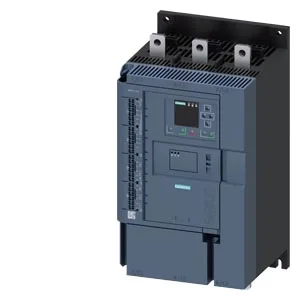
ATEX-rated soft starter for hazardous-area motor control
The Siemens 3RW5544-6HF14 is a soft starter with ATEX and IECEx certification, meaning it can be installed in Zone 1 or Zone 2 explosive atmospheres where motor starting must not create an ignition source. This is the defining differentiator from standard soft starters — the ATEX marking on the nameplate is what the site electrical engineer checks before signing off the hazardous-area loop. The trip class is selectable between CLASS 10A, 10E (default), 20E, or 30E per IEC 60947-4-2, so you match the thermal overload protection to the motor's starting profile — a high-inertia fan load gets 30E, a pump gets 10A.
Fieldbus and analog feedback for integrated control
This soft starter supports PROFIBUS, Modbus RTU, Modbus TCP, and EtherNet/IP natively — no separate communication module needed. The controls integrator can map the starter into a Siemens S7-1500 or Rockwell ControlLogix rack over the same network as the drives and I/O, reducing gateway hardware and programming overhead. An analog output configurable for 4-20 mA or 0-10 V provides motor current or voltage feedback to a PLC analog input, useful for remote monitoring without adding a separate transducer. The accuracy class is 5 per IEC 61557-12, adequate for trend monitoring and energy logging.
Safety functions and service factor margin
The safe state is open load circuit — when the fail-safe input (1 channel) is de-energized, the starter opens the motor circuit, meeting the stop category 0 requirement for emergency stops. The B10d value of 147,000 cycles supports the reliability calculation for the safety function per ISO 13849. Service factor 1.15 means the starter can deliver 115% of its rated current continuously without tripping, matching NEMA motor service factors. This is useful when the motor runs near its nameplate rating and the process occasionally demands a short overload — the starter holds without nuisance tripping.
Panel mounting and clearance dimensions
The enclosure measures 393 mm high, 210 mm wide, and 203 mm deep — a substantial footprint that needs a backplate area roughly 400 x 220 mm for the starter alone. Clearance requirements: 100 mm above, 75 mm below, 10 mm in front, 5 mm at the sides, and 0 mm behind. The 0 mm rear clearance means it can sit flush against the back panel, saving depth in the enclosure. Screw terminals are standard, so no special crimping tooling is needed for the power and control wiring. The terminal layout follows the Siemens 3RW5 series convention — power terminals at the top, control terminals at the bottom, fieldbus connector on the side.
Advanced motor protection and diagnostics
Motor heating protection, DC braking, torque control, voltage ramp, pump ramp down, and breakaway pulse are all built in — no external add-ons. The commissioning engineer can set the starting parameters (ramp time, initial torque, current limit) directly from the keypad or over the fieldbus, and log events to the internal error logbook for post-start analysis. The trace function captures current and voltage waveforms during starting, useful for diagnosing mechanical binding or supply dips that cause start failures. Auto-reset and remote reset options let the starter recover from a trip without a manual visit to the panel.