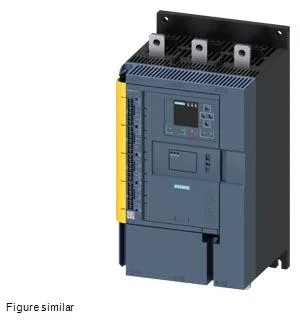
Hazardous-area motor starting with ATEX and IECEx certification
This Siemens 3RW5546-2HF04 soft starter carries both ATEX and IECEx certification, per the specification, making it suitable for motor starting in explosive atmospheres where equipment must meet the ATEX directive or IECEx scheme requirements. The rated voltage range of 200 to 480 V covers the common low-voltage networks across global industrial installations, and the unit is UL and CSA approved for North American panel acceptance.
Trip class flexibility per IEC 60947-4-2
The trip class is configurable as CLASS 10A, 10E (default), 20E, or 30E according to IEC 60947-4-2, which governs the maximum permissible stall time before the soft starter trips — CLASS 10A/10E for standard starting duty, 20E for higher-inertia loads, and 30E for very high-inertia loads such as centrifuges or crushers. A service factor of 1.15 allows continuous operation at 115% of the motor nameplate rating without exceeding thermal limits, per the datasheet figure.
Multi-protocol fieldbus integration
The soft starter supports PROFIBUS, Modbus RTU, Modbus TCP, and EtherNet/IP, as evidenced by the specification, enabling direct connection to most common industrial networks without additional gateways. PROFIenergy is supported in connection with PROFINET Standard and PROFINET High-Feature communication modules, allowing energy-saving shutdown of loads during production pauses.
Advanced motor control and diagnostics
Features include DC braking, voltage ramp, pump ramp down, torque control, and breakaway pulse — the pump ramp down function is particularly useful for preventing water hammer in pump applications by gradually reducing motor torque during stop. The unit includes an event list, error logbook, trace function, and analog output configurable as 4-20 mA or 0-10 V, per the specification, for detailed commissioning and fault analysis.
Panel integration and clearance dimensions
Physical dimensions are 210 mm width, 393 mm height, and 203 mm depth, with required clearances of 100 mm upwards, 10 mm forwards, 0 mm backwards, 75 mm downwards, and 5 mm at the side — these must be respected for adequate ventilation and safe operation. The unit uses screwless terminals (not screw terminal), so appropriate crimp tools and ferrules are needed for field wiring.