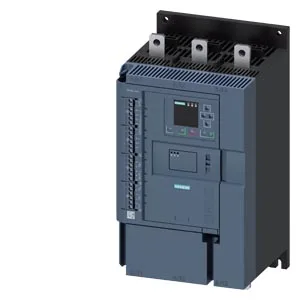
What the ATEX and trip-class ratings mean for a motor-starting circuit
The ATEX and IECEx certifications on this 3RW5547-6HA16 mean the soft starter can be wired into a motor branch circuit serving a Zone 2 or Zone 22 classified area, provided the upstream protection and enclosure meet the installation code. That is not a feature every soft starter in this current class carries — it is the deciding factor when the driven pump, fan, or conveyor sits in a gas or dust hazardous location. The trip class is selectable from CLASS 10A (the tightest thermal protection for submersible pumps or compressors that must not overheat on a stall) through 10E, 20E, and 30E per IEC 60947-4-2. The default is 10A/10E, which holds the rotor locked-rotor current time to 10 seconds at the motor's locked-rotor current — a standard that matches most general-purpose squirrel-cage motors. If the load has a longer acceleration profile (high-inertia centrifuge or induced-draft fan), stepping to 20E or 30E avoids nuisance trips during start without rewiring the starter.
Voltage envelope and fieldbus integration for a control panel
The control voltage accepts 110-250 V AC at either frequency, so the same part can be stocked for panels shipped to different regions provided the main power matches. Mounting dimensions are 210 mm wide by 393 mm tall by 203 mm deep. The screw terminals on the power and control wiring mean no special crimp tooling is needed for the panel shop — standard ring or fork terminals on the motor and line cables. Clearance requirements: 100 mm above, 75 mm below, 10 mm in front, 5 mm at the sides, and zero behind the unit. That zero-backwards clearance is a practical advantage when the panel backplate is already dense with other gear — the soft starter can sit flush against the mounting surface. Fieldbus connectivity includes PROFIBUS, Modbus RTU, Modbus TCP, and EtherNet/IP, plus PROFINET with PROFIenergy support when fitted with the high-feature communication module. That lets the starter report motor current, trip history, and thermal model status directly into the DCS or PLC without a separate analog card for each drive.
Motor control features that protect the load and the process
The voltage ramp start, torque control, and breakaway pulse give the commissioning engineer three ways to tune the acceleration profile. For a conveyor belt with a sticky start, the breakaway pulse delivers a short high-torque hit to break the belt free, then the voltage ramp takes over. For a pump, the pump ramp down feature extends the deceleration to prevent water hammer on valve closure — a standard cause of mechanical seal failures in water and wastewater service. DC braking is available for loads that must stop quickly without a mechanical brake — useful on saws or grinders where the motor coast time is a safety concern. The analog output (4-20 mA or 0-10 V, default 4-20 mA) can be mapped to motor current, so the PLC sees the actual load without a separate current transformer. The event list, error logbook, and trace function store the last several trip events with time stamps and parameter snapshots. When a motor trips on overload or phase loss, the trace shows the current waveform leading up to the fault — that data alone can decide whether the problem is in the load, the supply, or the motor windings, without putting a scope on the panel.
Lifecycle and compliance documentation for the BOM file
Compliance marks: CE for the European market, UL and CSA for North America, and ATEX/IECEx for hazardous locations. The accuracy class is 5 per IEC 61557-12, which governs the measurement accuracy of the integrated current and voltage sensing — relevant for energy monitoring applications where the panel must report motor power within ±5 %.