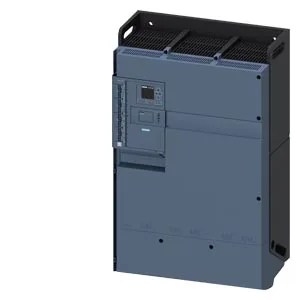
Soft starter for demanding motor starting applications
The Siemens 3RW5552-2HA06 is a SIRIUS soft starter rated for 200 to 690 V AC supply, covering low-voltage motor starting across global voltage standards. Its trip class is configurable as CLASS 10A / 10E (default) / 20E / 30E per IEC 60947-4-2, meaning you can match the thermal overload protection to the motor's starting profile — CLASS 10 for standard starts, CLASS 20 or 30 for high-inertia loads like crushers or centrifuges. ATEX and IECEx certification (both listed) qualifies this unit for explosive atmospheres — zones where a standard soft starter would be a safety risk. Combined with CE, UL, and CSA approvals, it ships into European, North American, and global mining, chemical, and oil-and-gas installations without requalification. Communication flexibility is built in: Modbus RTU, Modbus TCP, PROFIBUS, and EtherNet/IP are all supported, plus PROFIenergy for coordinated energy management on PROFINET networks. That means it integrates into existing plant-floor architectures — whether the line runs on Siemens S7, Rockwell ControlLogix, or a third-party PLC — without a separate gateway.
Motor control features that matter on the line
Voltage ramp, torque control, breakaway pulse, and pump ramp down are all standard. Voltage ramp lets you accelerate the motor smoothly, reducing mechanical shock on conveyors or compressors. Torque control maintains a set torque during start, useful for belt-driven loads. The breakaway pulse delivers a brief high-torque burst to break static friction on stuck loads, then reverts to the ramp profile. Pump ramp down extends the deceleration time to prevent water hammer in pumping stations. DC braking and combined braking provide controlled stopping without a separate brake resistor on many applications. The analog output is configurable as 4-20 mA (default) or 0-10 V, feeding motor current or torque data to a PLC or SCADA — useful for monitoring pump or fan load trends. An integrated error logbook, event list, and trace function simplify commissioning and fault finding. The trace captures motor current and voltage profiles during start events, so you can verify the ramp settings match the load without an external oscilloscope.
Physical integration and environmental limits
Dimensions are 478 mm wide, 764 mm high, and 241 mm deep — a substantial footprint that requires a large enclosure or dedicated section in the MCC. Clearance requirements: 100 mm above, 75 mm below, 10 mm in front, 5 mm to the side, and 0 mm behind. That means it needs free air flow above and below for natural convection cooling; mounting it tight against the top of a panel will derate the thermal performance. In a hot MCC room or desert installation, you'll need to either reduce the starting duty cycle or provide forced ventilation. The service factor of 1.15 means it can handle 115% of rated current continuously — but that margin shrinks as ambient temperature rises.