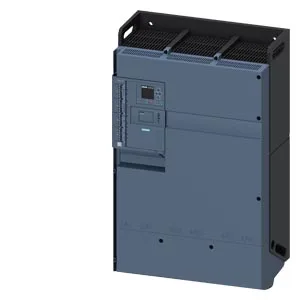
The 3RW5556-6HA14: The default trip class is CLASS 10A / 10E per IEC 60947-4-2, which limits the start duration to 10 seconds at six times rated current — enough for most centrifugal pumps and fans. For high-inertia loads like conveyors or crushers, the unit can be set to CLASS 20E or 30E, extending the start window without nuisance tripping. The voltage ramp, torque control, and breakaway pulse let the soft starter manage the motor's acceleration profile: the ramp reduces inrush current, the torque control limits mechanical shock, and the breakaway pulse gives a short high-torque burst to break a stuck load free before the ramp takes over. DC braking is built in — no external braking resistor needed for quick stops on conveyors or centrifuges where coast-down time is a safety or cycle-time issue.
Fieldbus and control — three network options on one unit
The soft starter supports Modbus RTU, Modbus TCP, and EtherNet/IP natively, so it connects to most PLC ecosystems (Siemens S7, Rockwell ControlLogix, Schneider M340) without an external gateway. PROFIBUS is also listed as present, covering legacy fieldbus installs. The analog output can be configured as 4–20 mA (default) or 0–10 V, feeding motor current or load status to a remote SCADA or local panel meter. The event list and error logbook store the last several faults with timestamps — useful for diagnosing nuisance trips without a laptop. Firmware updates are field-loadable, so the unit can be brought to the latest revision without swapping hardware.
ATEX and IECEx — certified for explosive atmospheres
The 3RW5556-6HA14 carries ATEX and IECEx certification, meaning it is approved for installation in Zone 1 or Zone 2 gas atmospheres and Zone 21 or Zone 22 dust atmospheres when paired with the appropriate motor and cabling. This is a differentiator — most soft starters in this power class lack the ATEX mark, so if the line runs in a hazardous area, this part is the one that passes the safety audit.
Panel fit — dimensions and clearances
The enclosure measures 764 mm high by 478 mm wide by 241 mm deep. Minimum clearances around the unit are: 100 mm above, 75 mm below, 10 mm in front, 5 mm at the sides, and 0 mm behind. That 0 mm rear clearance means it can sit flush against the back panel — useful when gland-plate space is tight. Screw terminals are standard — no special crimp tool or busbar kit required for the power connections.