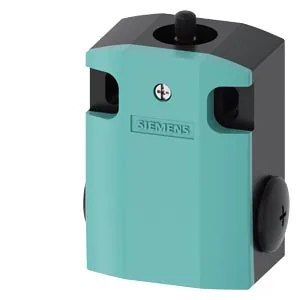
SIRIUS mechanical limit switch, still current
The 3SE5122-0CE01: The switch carries a positive-opening switching function compliant with EN 50041 on the actuator head, which is the defining safety feature for guard-door and position-monitoring duty where a stuck contact must be ruled out mechanically rather than by spring return alone.
Snap-action contacts, 10 A thermal, AC and DC derating
Inside the wide metal housing is a snap-action contact set with a thermal current rating of 10 A — the headline figure that tells you the limit switch is built for direct switching of contactor coils, small motor loads and solenoid valves rather than pure signal-level duty. Snap-action contacts also give clean switching edges into the PLC input — no chatter on slow cam approach, which is exactly what you want when the signal has to ride over a noisy VFD-fed plant floor.
IP66/IP67 block-wide housing, metal enclosure, three M20 entries
The enclosure is metal in the block-wide design, sealed to IP66/IP67 and finished with a cathodic dip coating — meaning the switch body and the cable entries withstand washdown, hose-down and outdoor exposure without water wicking into the terminals. Operating temperature runs -25 °C to +85 °C and storage -40 °C to +90 °C, so the switch handles unheated enclosures in cold-weather sites and the high-ambient pockets next to a motor without the plastic roller deforming.
Roller lever actuator and 0.05 mm repeat accuracy
The actuator head is a metal-lever roller plunger with a plastic roller, built per the EN 50041 standard actuator pattern — so a wide range of third-party replacement levers and specialty actuators (rod, fork, cat whisker) mount on the same shaft without adapter hardware. Repeat accuracy is 0.05 mm — the position-to-position scatter at the trip point — which is what lets the switch repeat a machine home position consistently enough for registration and indexing duty, not just end-of-travel guarding. Mechanical shock rating to IEC 60068-2-27 is 30 g / 11 ms, so a passing crash event on a conveyor or press doesn't take the contacts out of alignment.