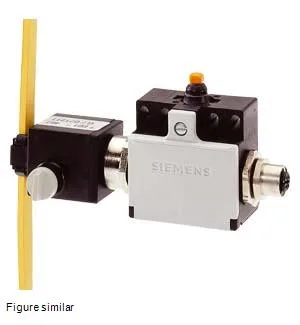
The Siemens 3SF3210-1GV00-0BA2 is a communication-capable position switch built for AS-interface networks. It reports its state — open or closed — directly onto the AS-i bus without a separate I/O module, which saves a cabinet slot and a wiring term per drop. The switch uses a mechanical active principle with a twist-lever actuator (roller crank, 10° to 10° switching angle) and a positive-opening NC contact that physically forces the contacts apart when the lever is released — that is the safety-relevant feature, required by EN 60947-5-1 for machine guarding circuits where a weld-seized contact must not mask a guard-open condition. Housing is a molded-plastic block per EN 50047, screw-fixed, rated IP65. That means the switch body is dust-tight and protected against water jets from any direction — suitable for washdown zones in food processing or outdoor conveyor transfer stations, though not for submersion. The twist lever can be oriented to match the cam approach direction on a sliding guard or a rotary actuator. One NC contact is provided; no NO contact. For a safety circuit that needs only a single normally-closed channel (e.g., a guard interlock wired into a safety relay or a safe PLC input), this is the right count. If your BOM calls for both NC and NO feedback, you would need a different variant or an auxiliary contact block.
AS-i connection: what it means for the wiring
Connection to the AS-i bus is via the insulation displacement method — the two flat cable conductors are pressed into the switch's piercing contacts without stripping the jacket. This is fast on assembly and eliminates a screw terminal that could loosen under vibration. The M12 connector on the adapter handles the AS-i power and data; the switch draws its operating power from the bus, so no separate 24 V supply wire is needed at the switch location.