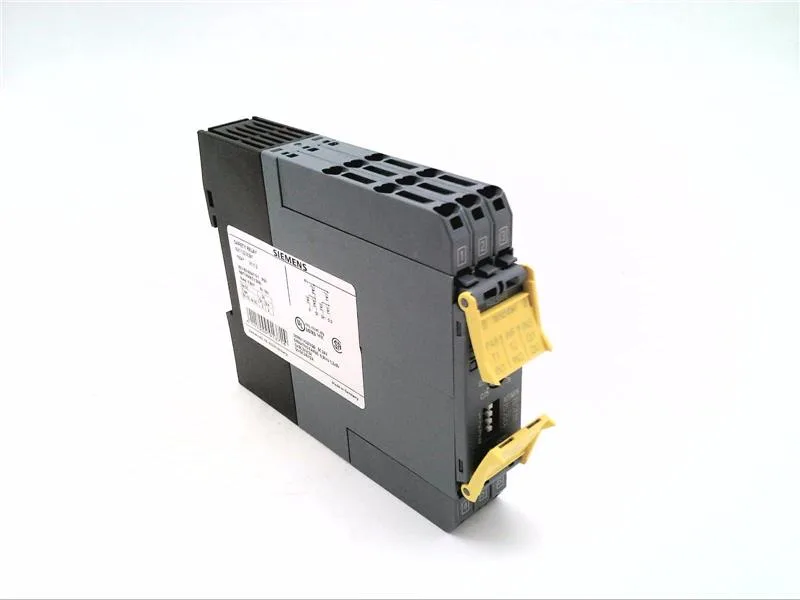
The Siemens 3SK1122-2CB41 is a SIRIUS safety relay with solid-state enabling circuits, designed for safety-related applications where you need reliable monitoring of emergency stops, safety gates, and light curtains. It's rated for 24 VDC supply and carries SIL 3 per IEC 61508 and PL e per ISO 13849-1 — that's the top performance level for most machinery safety circuits. The safe failure fraction sits at 99%, meaning the relay can detect nearly every internal fault that could compromise safety.
It can mount in any orientation, which helps when you're squeezing it into a crowded enclosure. The push-in terminals accept solid wire from 20 AWG to 16 AWG (single or doubled up) and stranded wire the same range. If you're using ferruled ends, the range drops to 0.5 to 1.0 mm². Strip length and ferrule size matter with spring clamps — use the recommended core-end processing to avoid terminal damage. Depth of 121.6 mm means it'll stick out a bit from the rail — check your enclosure depth if you're using shallow boxes. Height of 100 mm and width of 22.5 mm keep the footprint manageable.
The degree of pollution 3 rating means it's suitable for industrial atmospheres with conductive or dry non-conductive pollution — typical for control cabinets near machining or assembly areas. Power loss maxes out at 2 W, so heat buildup in a dense row of relays is manageable. Shock resistance is 10g for 11 ms, which covers most vibration scenarios in industrial equipment. EMC emitted interference meets IEC 60947-5-1, Class A — that's the industrial limit. In residential or light commercial zones you might need additional filtering or shielding, but in a factory it's fine as-is.
Safety logic and timing
The relay has two instantaneous safety contacts and two delayed switching contacts. Start input and feedback input are both present, so you can wire up external start buttons and monitor contactors or valves downstream. The cascading design lets you link multiple 3SK1 relays for expanded safety zones without extra logic modules. Sensor input minimum off-time is 60 ms — important when you're using light curtains or two-hand controls that need a defined off-before-on sequence. Maximum response time is 85 ms, and the typical off-delay is 6500 ms (6.5 seconds), which is the time the safety outputs stay on after the input signal drops. Operating frequency maxes at 2000 cycles per hour, so it's not for high-speed cycling but fine for normal machine guarding.