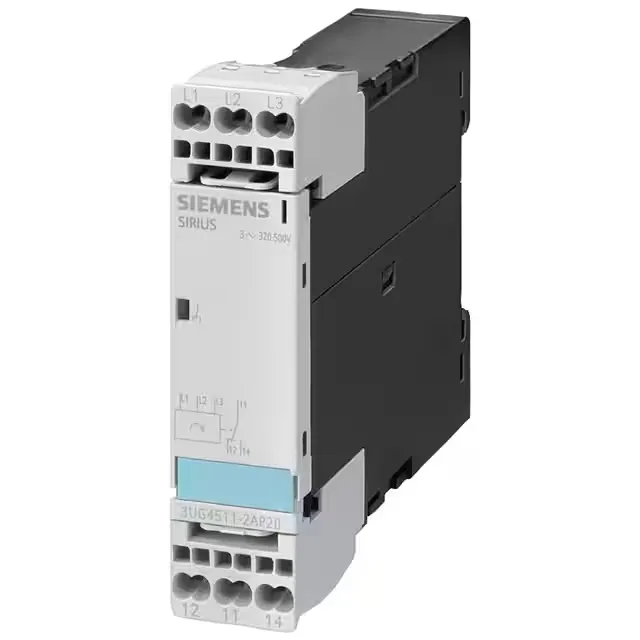
The Siemens 3UG4511-2AP20 is a SIRIUS phase monitoring relay — a single-function device that watches for phase loss, phase sequence, and undervoltage on three-phase AC supplies. It's the kind of part you drop into a motor feeder or a pump panel to keep the contactor from closing when the incoming line isn't healthy. Rated for 320 to 500 VAC at both 50 and 60 Hz, it covers the common European and North American 400 V distribution voltages. The output is a single changeover contact rated 3 A at 250/400 VAC, 50/60 Hz — enough to drive a contactor coil or a PLC input directly. The IP20 finger-safe housing means it's meant for an enclosed panel, not a washdown area.
The 320-500 VAC range is the nominal monitoring window — the relay will pick up and indicate healthy when all three phases are present and within that band. Below 320 V it drops out; above 500 V it's outside spec. The 50/60 Hz dual rating means you don't need a different variant for 60 Hz installations. Output contact ratings: 3 A at 250 VAC and 3 A at 400 VAC (both at 50/60 Hz), plus 1 A at 24 VDC, 0.2 A at 125 VDC, and 0.1 A at 250 VDC. That DC curve is typical for a relay of this size — fine for pilot duty, but don't plan on switching a DC motor contactor directly at the higher current. The relay has an auto-reset function — once the fault clears and the supply returns to normal, it will re-energize the output without a manual pushbutton. That's convenient for remote or unattended panels, but if you need a latching fault indication, you'll want to add a separate manual-reset relay or use the undervoltage detection option on a different model (this one does not have undervoltage detection). A green LED on the front shows operating status — handy for quick troubleshooting without dragging out a meter. The terminal block accepts 2 x 0.2 to 2.5 mm² solid or stranded wire (24 to 16 AWG), which covers most control-circuit wiring.
Dimensions: 22.5 mm wide, 84 mm tall, 91 mm deep. Snap-on mounting with zero clearance required on all sides — upwards, downwards, forwards, backwards, and sideways all read 0 mm. That means you can butt it against other components or the side of the enclosure without worrying about heat dissipation or access for wiring.