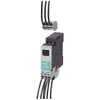
The 3UG4641-2CS20: The adjustable current range of 0.2 to 10 A covers a wide spread of motor and load sizes — from fractional-horsepower pumps up to about 5 kW at 400 V. You set the full-scale value digitally, and the relay trips when the active power (or cos phi) deviates beyond your programmed threshold. The 90-690 VAC supply range means it works on any standard low-voltage network worldwide, including 120 V, 208 V, 240 V, 400 V, 480 V, and 600 V systems, without needing a separate control transformer. The relay output is rated 3 A at 250 VAC and 3 A at 400 VAC, which is enough to drive a contactor coil or a PLC input directly. For DC loads, derate to 1 A at 24 VDC, 0.2 A at 125 VDC, and 0.1 A at 250 VDC — those lower figures matter if you're switching a DC-powered alarm beacon or a solenoid valve. The start-up delay is adjustable from 0 to 99 seconds, which lets you ignore inrush during motor starting or compressor cycling. That's a practical feature: without it, the relay would trip on every start transient. The external reset input means you can wire a remote pushbutton to acknowledge faults without opening the panel door.
Width is 22.5 mm, so it takes up one standard modular device slot — you can fit 12 of these in a 12-inch rail section. Height is 103 mm, depth 91 mm.
Wiring and connections
That's a standard control-panel range — 1.5 mm² is typical, and you can double up two conductors per terminal for daisy-chaining. The screw terminals are the cage-clamp style; strip length is around 8 mm. No special tooling required. Galvanic isolation is provided between input and output, and between the two output contacts (changeover). That means you can use the relay to switch a load on a different circuit without worrying about ground loops or shared neutrals.