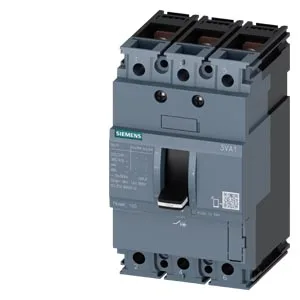
Three poles, so it switches three-phase loads: feeders, sub-distribution boards, or large motor circuits with separate overload protection upstream. Breaking capacity is 52.5 kA at 240 V AC, 32 kA at 415 V, 13.6 kA at 440 V, and 7.5 kA at 690 V. That range covers most low-voltage industrial and commercial panel applications. Dimensions are 130 mm high, 76.2 mm wide, 70 mm deep — a standard 3-pole MCCB footprint that fits most Siemens SENTRON panelboards and third-party enclosures with a 3-pole cutout.
Thermal derating — what the 100 A rating really means
At 55 °C it drops to 96 A, at 60 °C to 94 A, at 65 °C to 92 A, and at 70 °C to 90 A.
It also includes an undervoltage release (UVR); if the control voltage drops, the breaker opens. That UVR is the 3VA9608-0BB25 integrated auxiliary trip. Mechanical endurance is rated at 15,000 operations — standard for a distribution MCCB, not a high-cycle motor-switching device. The trip indicator is present, so a visual flag shows after a fault trip without opening the door.
How it compares to the 3VA1010-2ED42-0AE0
The closest functional peer is the 3VA1010-2ED42-0AE0 — same 100 A frame, same 3-pole, same TM210 release. The difference is in the auxiliary contact configuration: the -0DH0 carries 2 aux + 1 trip alarm (HQ), while the -0AE0 carries a different aux contact variant. If your BOM calls for the HQ aux set, the -0AE0 won't drop in without rewiring the status signals. The -0DC0 variant is another sibling with a different aux contact count. Verify the aux contact wiring diagram against your panel schematic before substituting.