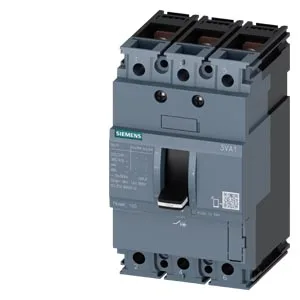
It is a 3-pole, line-protection version, meaning it's built for feeder and distribution circuits where you need to protect cables and busbars, not motor loads with their inrush curves.
Breaking capacity — what the voltages tell you
This breaker clears 52.5 kA at 240 V AC, 32 kA at 415 V, 13.6 kA at 440 V, and 7.5 kA at 690 V. At 690 V you're limited to 7.5 kA, so check your transformer size and cable run before committing.
Above that it starts to walk down: 96 A at 55 °C, 94 A at 60 °C, 92 A at 65 °C, and 90 A at 70 °C. That's the practical number for sizing, not the nameplate.
Auxiliary contacts and shunt trip — what's on board
The shunt trip is part number 3VA9688-0BL32 if you ever need a replacement.
No communication function onboard, so if remote monitoring is needed you'd add an external module or a separate power meter.
It has a trip indicator (mechanical flag) so you can see at a glance whether the breaker tripped on fault vs. being manually switched off — useful when you're walking a row of breakers after a nuisance trip. The voltage trigger refers to the shunt trip release: apply voltage to that coil and the breaker opens remotely, which is how you'd integrate it with an emergency-stop circuit or a PLC-driven shutdown sequence.