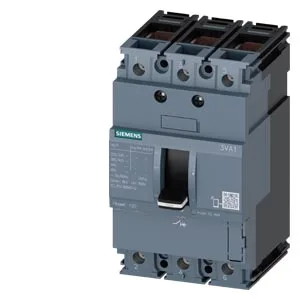
Breaking capacity is 52.5 kA at 240 V AC, dropping to 32 kA at 415 V and 13.6 kA at 440 V. Thermal derating is minimal up to 50 °C — still 100 A. At 55 °C it drops to 98 A, at 65 °C to 94 A, and at 70 °C to 91 A. For a panel with a 40 °C ambient design target, you get full rating; if the panel runs hot (say 55 °C inside a non-ventilated enclosure), you lose only 2 A. That keeps the wire sizing simple.
What you don't get — and why that matters for BOM accuracy
The design is strictly line protection — overcurrent and short-circuit only. If your spec calls for remote tripping or ground-fault alarm, you need a different 3VA suffix (e.g., a -2ED36-0AC0 with the UVR option, or a -2ED32-0AD0 with a different trip curve). The 3VA1010-2ED36-0AA0 is a pure thermal-magnetic breaker with no auxiliary electronics. Compared to the 3VA1010-2ED32-0AD0, the -2ED36-0AA0 shares the same frame, pole count, and 100 A rating but uses the TM210 release instead of the TM240. The -2ED32-0AD0 has a different trip-threshold curve; swapping one for the other changes the coordination study.
Depth of 70 mm (2.76 in) leaves room for rear bus bars or a gland plate behind the breaker. Maximum power loss is 25 W at rated current. In a sealed, non-ventilated enclosure with multiple breakers, factor that into the thermal budget — a 4-breaker panel dissipates 100 W just from these MCCBs. Suitable for unheated warehouses or outdoor enclosures in moderate climates, provided the ambient inside the enclosure stays within the derating curve.