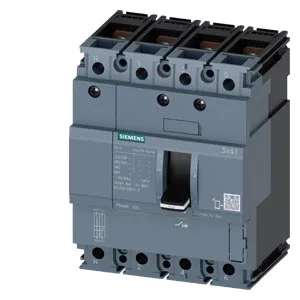
What this MCCB is and what it protects
The Siemens 3VA1010-2ED42-0CA0 is a SENTRON molded case circuit breaker (MCCB) designed for line protection in distribution panels. It carries a continuous current rating of 100 A at 40 °C, with negligible derating up to 50 °C — still 100 A — then dropping to 98 A at 55 °C and 91 A at 70 °C, so it holds its full rating in most ventilated enclosures without a derate calculation. Its 4-pole construction covers three-phase plus neutral, and the TM210 thermal-magnetic overcurrent release provides fixed thermal and magnetic trip settings for standard feeder or main breaker duty. The unit includes an integrated undervoltage release (UVR), so it can be wired to a safety circuit or emergency-stop chain to drop the breaker on loss of control voltage.
Breaking capacity — what the numbers mean for your fault duty
The interrupting rating varies sharply with line voltage: 52.5 kA at 240 V, 32 kA at 415 V, 13.6 kA at 440 V, and 7.5 kA at both 500 V and 690 V. At 415 V — common in European industrial distribution — the 32 kA SCCR covers most transformer-fed secondary faults without needing a current-limiting upstream device. At 690 V the 7.5 kA figure is the limiting factor; verify available fault current at the point of installation. Rated insulation voltage is 800 V, so the breaker's internal clearance and creepage are designed for 690 V systems with margin.
Panel fit and environmental limits
Dimensions are 101.6 mm wide, 130 mm high, and 70 mm deep — a 4-inch wide footprint that matches the SENTRON 3VA family mounting pattern. It bolts into a standard MCCB panel cutout; no DIN-rail adapter is needed. Operating temperature range is -25 °C to 70 °C, with storage from -40 °C to 80 °C. Maximum power dissipation is 27.5 W, so adjacent devices in a sealed enclosure need that heat accounted for in the thermal budget.
