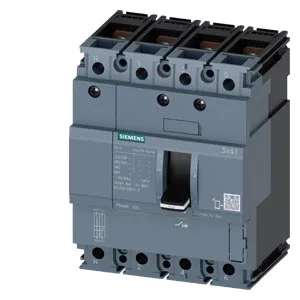
SENTRON 3VA1010-2ED42-0HH0 — 100 A MCCB with TM210 Release and Shunt Trip
The Siemens SENTRON 3VA1010-2ED42-0HH0 is a 4-pole molded case circuit breaker (MCCB) rated for 100 A continuous current at 40 °C, with a TM210 thermal-magnetic overcurrent release. Its interrupting capacity hits 52.5 kA at 240 V, 32 kA at 415 V, and 7.5 kA at 690 V — the 415 V figure is the one to size against for most European industrial distribution panels. It's a line-protection breaker for fixed-installation feeder and branch circuits where you need a coordinated trip curve and don't need the extra monitoring layers.
Sizing and Thermal Derating — What the 100 A Rating Actually Means
The 100 A rated continuous current (Iu) holds flat from 40 °C through 50 °C ambient, then derates to 96 A at 55 °C, 94 A at 60 °C, 92 A at 65 °C, and 90 A at 70 °C. If your panel ambient runs 55 °C or higher — common in sealed enclosures near process heat — you lose 4–10 A of headroom. The TM210 release is a fixed-thermal, fixed-magnetic design; no interchangeable rating plugs. For a 100 A feeder feeding a 90 A continuous load, you're fine. For a 100 A feeder feeding a 95 A continuous load at 55 °C ambient, you're already at the edge of the derated curve.
The 52.5 kA at 240 V is the headline number, but the 32 kA at 415 V is the practical rating for most 400 V-class industrial panels. At 690 V it drops to 7.5 kA — still sufficient for most 690 V motor circuits where the fault current at the MCC is typically under 10 kA. For selectivity coordination downstream of a larger SENTRON 3VA or 3WL frame, the TM210's fixed thermal curve is well-documented in Siemens selectivity tables; the shunt trip allows remote tripping from a safety PLC or emergency-stop circuit.
That 101.6 mm width is a standard 4-pole MCCB footprint — it occupies four 25.4 mm (1-inch) module positions on a DIN rail or direct panel-mount plate. No communication function, no phase-failure detection — this is a straightforward thermal-magnetic breaker with remote trip capability, not a smart breaker.