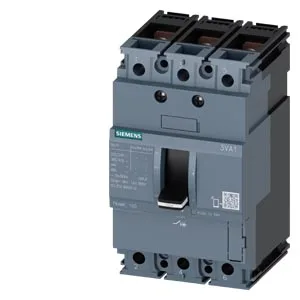
It's a 3-pole unit rated for a continuous current of 100 A at 40 °C, and it holds that full 100 A all the way up to 50 °C before it starts to derate (96 A at 55 °C, 94 A at 60 °C, 92 A at 65 °C, 90 A at 70 °C). That thermal curve is what you check when the panel ambient runs hot — if your enclosure hits 60 °C, you're still good for 94 A continuous. The overcurrent release is a TM210 — a thermal-magnetic type with a fixed thermal pickup and a magnetic short-circuit trip set at 10× In (1000 A). That's a standard distribution release curve, not the adjustable electronic kind you'd find on a selective or motor-protection variant. For the short-circuit side, the breaker is rated for 75.6 kA at 240 V, 52.5 kA at 415 V, 32 kA at 440 V, and 7.5 kA at 690 V — those are the interrupting capacities at each voltage level, and they tell you whether this breaker clears a fault before the upstream device has to act. It ships with an integrated undervoltage release (UVR) as standard — that's the / entry: the coil drops the breaker if control voltage is lost, which is common on emergency-stop circuits or mains-monitoring schemes.
IP40 front protection. Mechanical endurance is 15,000 operations.