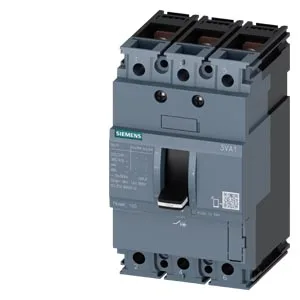
It carries a TM210 thermal-magnetic overcurrent release — the TM210 designation means the thermal fixed trip is set at 100 A (the full rated current) and the magnetic short-circuit pickup is 10× In (1000 A), making it a standard motor-branch or feeder breaker, not a high-magnetic version for transformer inrush. The shunt trip (STL) auxiliary release allows remote tripping via a separate control voltage, which is how this breaker integrates into an emergency-stop chain or a fire-safety loop.
Breaking capacity — the real coordination figure
This MCCB's interrupting capacity is voltage-dependent: 75.6 kA at 240 V, 52.5 kA at 415 V, 32 kA at 440 V, and 7.5 kA at both 500 V and 690 V. The steep drop above 440 V is typical of a compact-frame breaker — at 690 V the 7.5 kA figure limits it to low-fault applications (small transformers, secondary feeders) unless upstream current-limiting fuses or a larger-frame breaker provide backup protection. For a 415 V panel with a prospective fault current above 52.5 kA, this breaker needs a series-rated combination or a higher-interrupting variant from the 3VA family.
Physical footprint is 130 mm tall, 76.2 mm wide (3 in), and 70 mm deep (2.76 in). The 3-pole width matches standard Siemens 3VA fixed- and plug-in-base mounting, so it swaps directly into existing SENTRON panel layouts without bus-bar rework.