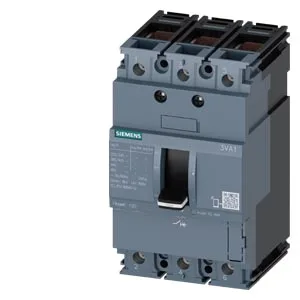
The Siemens SENTRON 3VA1010-3ED36-0CA0 is a 3-pole molded case circuit breaker rated for 100 A continuous at 40 °C, with a TM210 thermal-magnetic overcurrent release designed for line protection. The interrupting ratings climb to 75.6 kA at 240 V and 52.5 kA at 415 V, then taper to 7.5 kA at 690 V — so the available fault current at the panel's service voltage determines whether this breaker clears a short without upstream coordination issues. The undervoltage release (UVR) built into this order code means the breaker trips on loss of control voltage, a common requirement for emergency-stop or safety circuits where a drop-out must isolate the load.
Thermal derating and enclosure planning
The 100 A rating holds flat through 50 °C ambient, then derates to 98 A at 55 °C, 96 A at 60 °C, 94 A at 65 °C, and 91 A at 70 °C. In a sealed panel with multiple breakers ganged, that curve determines the real load you can protect without nuisance tripping. Maximum power loss is 27.5 W, which factors into the enclosure's thermal budget when grouping several breakers in a confined space.
The 130 mm height and 70 mm depth leave clearance for standard busbar connections and outgoing cable lugs. No communication module or ground-fault monitoring is integrated — this is a plain line-protection breaker with undervoltage release only.
Environmental and compliance range
No trip indicator or voltage-trigger accessory is fitted on this variant — the UVR is the only auxiliary release.