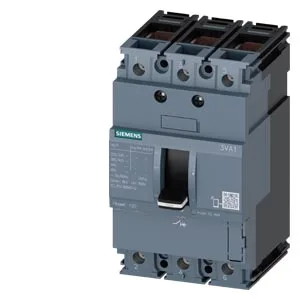
The shunt trip (STL) release lets a remote signal (emergency stop, fire alarm, or PLC output) force the breaker open without a person at the panel. Rated 100 A at 40 °C, it holds that full rating up to 50 °C, then derates to 91 A at 70 °C — useful to know if this breaker lives in a hot enclosure near other heat sources. Breaking capacity is voltage-dependent: 75.6 kA at 240 V, 52.5 kA at 415 V, 32 kA at 440 V, and 7.5 kA at 500 V and 690 V.
The 3VA1010-3ED36-0HA0 measures 130 mm high, 76.2 mm wide, and 70 mm deep — a 3-pole MCCB that mounts on a DIN rail or bolts directly into a panel. The 76.2 mm width is a standard 3-pole frame for this SENTRON series; it occupies three adjacent 25.4 mm module positions on the rail. Depth of 70 mm means it clears most standard enclosure depths, but check the handle-horn clearance if the panel door has a rotary operator.
Maximum power loss is 25 W; in a sealed, non-ventilated enclosure that heat adds to the ambient rise calculation. The shunt trip release is factory-installed (not a field-addon kit), so verify the control voltage matches your trip-coil circuit before specifying.