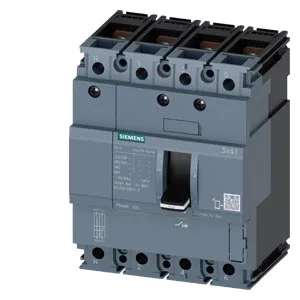
Siemens SENTRON 3VA1010-3ED42-0DC0 — 100 A MCCB with Undervoltage Release
The interrupting capacity reaches 75.6 kA at 240 V, stepping down to 52.5 kA at 415 V and 32 kA at 440 V — figures that govern its fault-clearing capability in a distribution panel.
Current Rating and Thermal Behavior
The 100 A rating holds steady from 40 °C through 50 °C, then derates linearly: 98 A at 55 °C, 96 A at 60 °C, 94 A at 65 °C, and 91 A at 70 °C. For a panel that runs warm — say, 55 °C ambient inside the enclosure — the usable current drops to 98 A. That 2 A difference matters when the breaker is feeding a continuous load near its nameplate; the thermal curve is the real limit, not the 100 A sticker.
At 415 V — common in European industrial panels — it still clears 52.5 kA. At 440 V it drops to 32 kA, and at 500 V and 690 V it holds at 7.5 kA. Selectivity studies should use the voltage-specific value, not the headline number.
The UVR is wired into the control circuit; when voltage falls below its dropout threshold, it mechanically trips the breaker. That is a standard safety interlock for conveyors, pumps, or any load where unexpected restart after a brownout is hazardous.
Dimensions are 130 mm height, 101.6 mm width, and 70 mm depth. The 101.6 mm width (4 inches) is the standard footprint for a 4-pole SENTRON 3VA1 frame; it occupies four 25.4 mm module positions on a DIN rail or mounting plate. No trip indicator is fitted, so a visual check of the handle position is the only local status cue.