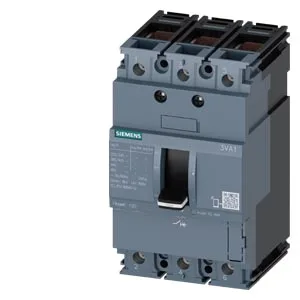
What this MCCB is and what it does
The Siemens 3VA1010-4ED36-0AF0 is a SENTRON molded case circuit breaker (MCCB) designed for line protection — meaning it sits upstream of a distribution bus or feeder, not on a specific motor or device. It's a 3-pole unit rated 100 A continuous at 40 °C, with a TM210 thermal-magnetic overcurrent release that handles both overload and short-circuit trip curves. The interrupting ratings climb steeply as voltage drops: 121 kA at 240 V, 75.6 kA at 415 V, 52.5 kA at 440 V, and 11.9 kA at both 500 V and 690 V. That spread tells you it's built for high-fault-capacity main or subfeed applications where you need selectivity with downstream breakers. Insulation voltage is rated 800 V, so it's comfortable on 480/277 V or 600 V systems with headroom.
Sizing and thermal derating
The 100 A rating holds flat from 40 °C up to 50 °C (–). Above that it derates: 98 A at 55 °C, 96 A at 60 °C, 94 A at 65 °C, and 91 A at 70 °C. Operating ambient range is -25 °C to 70 °C; storage range is -40 °C to 80 °C. Maximum power loss is 25 W — that's the heat you need to vent inside the enclosure if the breaker is fully loaded. The TM210 release is the thermal-magnetic type, so no electronic adjustment; the trip curve is fixed by the thermal element and magnetic pickup.
Physical fit and panel integration
The breaker measures 70 mm deep, 76.2 mm wide, and 130 mm tall — that's roughly 2.76 by 3 by 5.12 inches (–). It's a standard SENTRON 3VA frame size, so it mounts on a DIN rail or panel-mount base plate with the usual screw terminals. The auxiliary switch configuration is one auxiliary switch plus one trip alarm switch HQ, which lets you signal the breaker state (open/closed/tripped) back to a PLC or annunciator panel. No undervoltage release, no voltage trigger, no ground-fault monitoring, and no communication function — this is a plain-vanilla thermal-magnetic MCCB for straightforward line protection.
