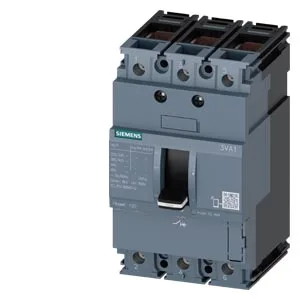
It carries a continuous current rating of 100 A at 40 °C, derating to 91 A at 70 °C, and uses a TM210 thermal-magnetic overcurrent release — the fixed thermal element handles overloads, while the magnetic trip responds to short-circuit events. Breaking capacity is voltage-dependent: 121 kA at 240 V, 75.6 kA at 415 V, 52.5 kA at 440 V, and 11.9 kA at both 500 V and 690 V. That means on a 480 V system (common in North American industrial plants) you get the 52.5 kA rating at 440 V — ample headroom for most service-entrance and feeder applications where available fault current is under 50 kA.
Dimensions are 130 mm high, 76.2 mm wide, and 70 mm deep — a standard 3-pole MCCB footprint that fits SENTRON distribution boards and most DIN-rail-mounting adapter plates. The 76.2 mm width (3 inches) matches the typical 3-pole module pitch, so it occupies three 25.4 mm positions on a panel grid.