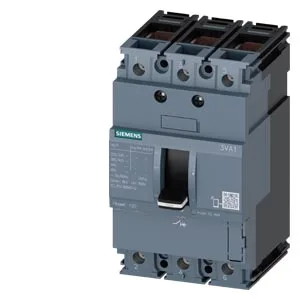
It's sized for 100 A continuous at 40 °C, and that rating holds flat through 50 °C — no derate needed until you push past 55 °C, where it steps down to 98 A, then 96 A at 60 °C, 94 A at 65 °C, and 91 A at 70 °C. Breaking capacity is the headline here: 121 kA at 240 V, 75.6 kA at 415 V, 52.5 kA at 440 V, and 11.9 kA at both 500 V and 690 V. That's a lot of fault-current headroom for a 100 A frame — it'll clear a high-energy fault without cascading upstream, which matters when you're coordinating a distribution panel and don't want every breaker tripping on a downstream short.
Undervoltage release and panel fit
That's a common requirement for motor feeder circuits where you want the breaker to drop out on loss of control power, preventing an automatic restart when power returns. No ground-fault monitoring module is included; this is a straight thermal-magnetic line-protection breaker. The case dimensions are 130 mm high, 76.2 mm wide, and 70 mm deep — a standard 3-pole MCCB footprint that drops into most SENTRON panelboards and distribution blocks without fit issues. The trip indicator is not present on this variant, and there's no communication module onboard; it's a plain breaker, no Modbus or PROFIBUS link.