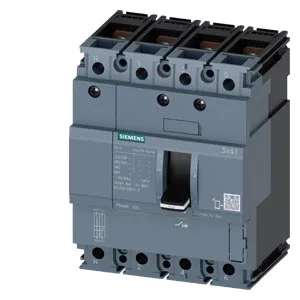
Above that, the thermal curve steps down: 98 A at 55 °C, 96 A at 60 °C, 94 A at 65 °C, and 91 A at 70 °C. The TM210 overcurrent release combines a thermal-magnetic trip for overload and short-circuit protection. Four poles handle three-phase plus neutral or a second protected phase, depending on your system configuration.
Breaking capacity — where it interrupts
This MCCB delivers 121 kA at 240 V AC, 75.6 kA at 415 V, 52.5 kA at 440 V, and 11.9 kA at both 500 V and 690 V. The 121 kA figure at 240 V covers high-fault service-entrance applications on 240/120 V split-phase or 240 V three-phase. At 415 V, the 75.6 kA rating suits most European industrial panelboards where the transformer secondary can deliver serious fault current. The drop at 690 V to 11.9 kA is still adequate for many 690 V motor control centers — check your available fault current before specifying.
Built-in auxiliary switching and trip indication
That gives you remote status for open/closed and a separate signal for fault trips — no need to add a later module. The trip indicator on the front confirms the breaker opened on a fault vs. manual switching, which speeds up troubleshooting on a downed line.
The 4-inch (101.6 mm) width is the standard 4-pole MCCB footprint for this class — it occupies the same slot as other SENTRON 3VA 4-pole units. Depth of 70 mm (2.76 in) means it clears most shallow enclosures without a gland-plate extension. Mounting is via the rear slots or optional DIN-rail adapter; check your panel's rail spacing if retrofitting.
Environmental limits and power loss
Maximum power dissipation is 25 W at rated load — relevant for thermal calculations in sealed enclosures.