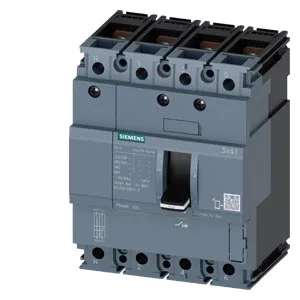
The thermal-magnetic release is a TM210, a fixed-trip type that needs no field adjustment — set and forget for distribution panels.
Breaking capacity — what the voltage columns tell you
This MCCB delivers 121 kA at 240 V, 75.6 kA at 415 V, 52.5 kA at 440 V, and 11.9 kA at 690 V — the full SCCR curve across common industrial voltages. At 415 V — the standard three-phase distribution voltage in much of Europe and Asia — 75.6 kA puts it comfortably above the 50 kA or 65 kA that most main switchboards require, giving selectivity headroom for downstream feeders. The 690 V figure (11.9 kA) is low enough that you need to check coordination if this breaker sits on a 690 V bus; it's not a high-fault device at that voltage.
Rated 100 A from 40 °C through 50 °C ambient, then derates to 96 A at 55 °C, 94 A at 60 °C, 92 A at 65 °C, and 90 A at 70 °C — a mild drop that reflects the TM210's thermal element staying stable until the upper end of the operating range.
Dimensions are 130 mm height, 101.6 mm width, 70 mm depth — a 4-pole MCCB that fits standard SENTRON mounting footprints; the 101.6 mm width is exactly 4 × 25.4 mm (4 module spaces) on a DIN rail or panel-mount adapter.