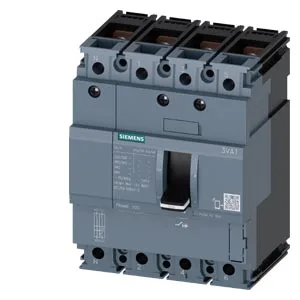
Siemens 3VA1010-4ED42-0KC0 — 100 A SENTRON MCCB for Line Protection
The Siemens 3VA1010-4ED42-0KC0 is a 4-pole SENTRON molded case circuit breaker rated for 100 A continuous current, built for line protection duty. Its TM210 thermal-magnetic release provides overload and short-circuit protection without undervoltage or ground-fault monitoring — a clean, no-frills breaker for straightforward feeder or main-switch applications. Interrupting capacity is the headline: 121 kA at 240 V, 75.6 kA at 415 V, 52.5 kA at 440 V, and 11.9 kA at 690 V. That 121 kA at 240 V tells you this breaker handles high-fault utility or transformer-fed panels without cascading upstream — a key selectivity point when coordinating downstream feeders. Current rating holds flat at 100 A through 50 °C, then derates to 96 A at 55 °C, 94 A at 60 °C, 92 A at 65 °C, and 90 A at 70 °C. If your panel ambient runs above 50 °C, size the load side accordingly — the derating curve is the real-world limit, not the nameplate 100 A.
Panel Fit and Mounting
Dimensions: 70 mm deep, 101.6 mm wide, 130 mm tall. The 101.6 mm width (4-inch footprint) is standard for a 4-pole MCCB in this class — drops into existing SENTRON or comparable panel layouts without re-drilling the mounting plate. Front IP40 protection keeps dust out of the enclosure face; the breaker body itself is open-frame behind the panel. Two auxiliary switches (HQ type) are integrated, giving status feedback for the open/closed position. The shunt trip (STL) release allows remote tripping — wired to an E-stop or PLC output, it drops the breaker without a manual handle pull. No undervoltage release or communication module on this variant; if you need remote monitoring or undervoltage lockout, step to a different 3VA option. Rated insulation voltage is 800 V, covering 480/600 V class systems with margin. Operating temperature range -25 °C to 70 °C; storage from -40 °C to 80 °C. The 15 000 latching endurance cycles suit frequent-switching applications like compressor or pump panels, not just infrequent fault protection.
