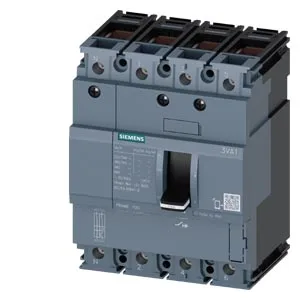
What this MCCB carries and where it fits
The Siemens SENTRON 3VA1010-4ED46-0AH0 is a 4-pole molded case circuit breaker (MCCB) rated for line protection — the core job is protecting cables and busbars from overload and short circuit in a distribution panel. Its TM210 thermal-magnetic release means the thermal element handles overloads and the magnetic element handles short-circuit events, with a fixed magnetic trip threshold set at 210 A (10× the 20 A frame). The interrupting capacity is the headline: 187 kA at 240 V, 121 kA at 415 V, 76 kA at 440 V, and still 17 kA at 500 V and 690 V. That 187 kA at 240 V is a high-rupturing figure — it lets this breaker sit at the service entrance or on a high-fault bus where downstream breakers need a current-limiting upstream device to stay within their SCCR. The 20 A continuous rating holds flat from 40 °C through 55 °C (no derating needed in a warm enclosure), then drops to 19 A at 60 °C and above.
Panel integration and wiring notes
The 3VA1010-4ED46-0AH0 mounts on a DIN rail or panel-mount baseplate — the 130 mm height and 4-inch width fit standard SENTRON 3VA cutout patterns. The front face carries an IP40 rating, so it is suitable for enclosed distribution boards where tools or fingers are the main concern, not washdown. It ships with 2 auxiliary switches plus 1 trip alarm switch (HQ version) factory-installed, which means you can wire status feedback to a PLC or annunciator without adding a separate accessory block. The TM210 release is non-interchangeable; if the application needs a different trip curve or rating, you step to a different 3VA variant rather than swapping the trip unit in the field.
Electrical ratings that govern the selection
Rated insulation voltage Ui is 800 V, which covers 480/277 V and 600 V systems with margin. Maximum rated operational voltage with DC is 600 V, so this 4-pole breaker can also serve in DC combiner boxes or battery circuits if the poles are series-connected per the Siemens manual. The storage temperature range (-40 °C to 80 °C) exceeds the operating range (-25 °C to 70 °C), meaning the breaker can sit in an unheated warehouse or be shipped through cold climates without damage. No undervoltage release, no shunt trip, no ground-fault monitoring, and no communication module are fitted on this variant — it is a straight thermal-magnetic line-protection device with auxiliary contacts only.
