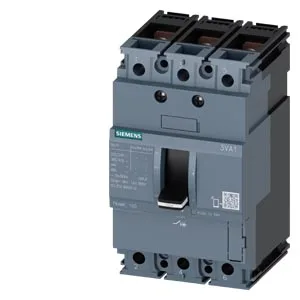
The 52.5 kA breaking capacity at 240 V is the headline number, but the figure that governs most industrial panels is the 32 kA at 415 V — that is the standard three-phase low-voltage distribution voltage in much of the world, and 32 kA is substantial headroom for a 20 A frame. At 690 V it still interrupts 7.5 kA, enough for most 690 V line-side applications. The thermal derating curve is published: the breaker holds 20 A flat from 40 °C through 50 °C, then drops to 19.2 A at 55 °C, 18.8 A at 60 °C, 18.4 A at 65 °C, and 18 A at 70 °C. That means in a warm panel — say 50 °C ambient — you still get the full 20 A rating. At 60 °C you lose about 1.2 A. Useful for remote trip indication in a PLC or SCADA system. The breaker has no undervoltage release, no shunt trip (voltage trigger), no communication function, and no phase failure detection — it is a plain thermal-magnetic MCCB, not a smart or electronically controlled unit.
The 3VA1020-2ED32-0AH0 measures 76.2 mm wide, 130 mm high, and 70 mm deep. The 76.2 mm width is a standard 3-pole MCCB footprint for the 3VA frame — it matches the panel cutout and busbar spacing of other 3VA 3-pole units. Mechanical endurance is rated at 15,000 operations — that is the number of on-off cycles the mechanism is designed to withstand under no-load conditions. For a line-protection MCCB that is cycled infrequently (a few times a year for maintenance isolation), this is more than adequate. If the breaker will be switched daily as a disconnect, the endurance figure is something to keep in mind.