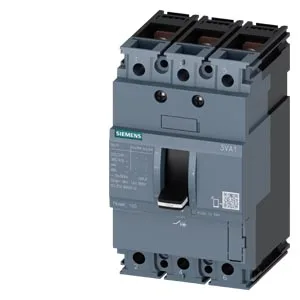
Its interrupting capacity reaches 52.5 kA at 240 V, 32 kA at 415 V, 13.6 kA at 440 V, and 7.5 kA at 690 V — so it handles fault currents all the way up to the 690 V level common in industrial distribution. The breaker ships with an integrated undervoltage release (UVR) but no auxiliary contacts, no communication module, and no ground-fault monitoring; it is a straight line-protection device for panel builders who need a clean, no-frills MCCB on a DIN rail.
Thermal derating — what the 20 A rating actually means at panel temperature
At 55 °C it derates to 19.2 A, at 60 °C to 18.8 A, at 65 °C to 18.4 A, and at 70 °C to 18 A. That is the figure to use for the load schedule, not the 20 A nameplate.
That 76.2 mm width is a standard 3-pole MCCB footprint — it occupies three 25.4 mm (1-inch) module positions on a DIN rail.
What the TM210 release and UVR mean for commissioning
The TM210 is a fixed thermal-magnetic release — no interchangeable rating plugs. The thermal element tracks the derating curve above; the magnetic pickup is factory-set for the 20 A frame. No trip indicator on the front, so a remote indication requires adding an auxiliary contact block (not included). Endurance is rated at 15,000 electrical operations — fine for a distribution feeder, not for frequent switching duty.