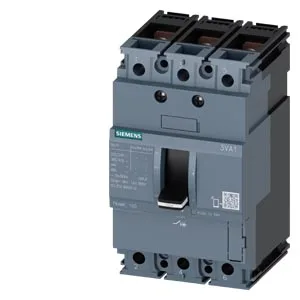
It carries a rated current of 20 A across the 40 °C to 55 °C band, derating to 19 A at 60 °C through 70 °C — so it holds full rating in most ventilated enclosures and only loses 1 A in a hot cabinet. Breaking capacity is 52.5 kA at 240 V, 32 kA at 415 V, 13.6 kA at 440 V, and 7.5 kA at both 500 V and 690 V. That means it can interrupt fault currents up to 52.5 kA on a 240 V line — enough for most low-voltage industrial service entrances — and still clear 7.5 kA at 690 V, covering motor circuits on 480/600 V systems. Maximum power loss is 12 W — negligible for panel thermal budgeting but worth noting if densely packed.
The shunt trip lets a remote PLC or E-stop circuit open the breaker without a manual handle pull — useful for emergency-off chains or interlocked machine zones. The auxiliary switches report breaker position back to the control system; the trip alarm switch signals a fault trip separately from a manual open, so a maintenance team knows whether it was a commanded stop or a protective trip. No undervoltage release is fitted (: No), and no ground-fault monitoring module is included (: Without). If you need UVR or GF protection, this is not the variant — you would step to a 3VA1 with those options. Communication function is also absent (: No); this is a standalone breaker, not a metering or networked unit.
The breaker measures 76.2 mm wide, 130 mm tall, and 70 mm deep — a standard 3-pole MCCB footprint that fits SENTRON distribution boards and most DIN-rail-mounting adapters. A trip indicator and a voltage trigger are present, giving visual and electrical confirmation of a tripped state — helpful for panel walk-downs and remote monitoring via the auxiliary contacts.