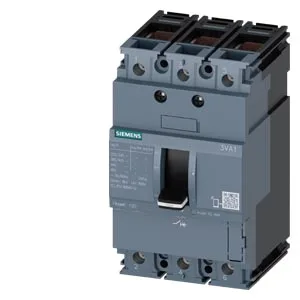
Rated 20 A continuous at 40 °C, it carries a solid 52.5 kA interrupting capacity at 240 V AC — enough to handle a stiff utility fault without upstream coordination headaches.
Breaking capacity — where it matters
This MCCB delivers 52.5 kA at 240 V, 32 kA at 415 V, 13.6 kA at 440 V, and 7.5 kA at both 500 V and 690 V. That's a strong curve for a 20 A frame — the high 240 V number means it's a good fit for North American 120/240 V split-phase panels where available fault current can run high. At 690 V the 7.5 kA still covers most industrial motor branch circuits.
Thermal performance and panel fit
The 20 A rating holds steady from 40 °C up to 55 °C, then only drops to 19 A at 65 °C and 70 °C. That's a tight derating curve — you don't lose headroom in a warm enclosure. Dimensions are 130 mm tall, 76.2 mm wide, and 70 mm deep, which is the standard 3VA1 footprint.
The UVR means the breaker drops out on loss of control voltage — standard for safety circuits where a machine must isolate on power loss. The trip alarm switch gives a positive signal when the breaker trips on fault, not just manual open. Max power loss at rated load is 14.5 W, which is modest for a 3-pole 20 A MCCB with auxiliaries.