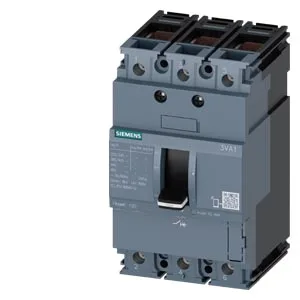
The TM210 release means the thermal pickup is fixed at 20 A — no field adjustment on the thermal element — and the magnetic short-circuit trip is set to 210 A (10x In). That 20 A rating holds flat from 40 °C up to 55 °C, then derates to 19 A at 60 °C and 65 °C, and stays at 19 A through 70 °C. For a panel builder, that means you can run it at full rating in a warm enclosure without derating until you cross 55 °C ambient. Breaking capacity is 52.5 kA at 240 V AC, 32 kA at 415 V, 13.6 kA at 440 V, and 7.5 kA at both 500 V and 690 V. That covers most industrial distribution panels fed from a transformer up to about 1000 kVA.
Dimensions are 76.2 mm wide (3 in), 130 mm tall (5.12 in), and 70 mm deep (2.76 in). That covers unheated electrical rooms and outdoor enclosures in most climates, though the derating curve above 55 °C needs to be factored into the load schedule.
The closest peer is the 3VA1020-3ED36-0AA0. Both are 3-pole, 20 A, TM210 breakers with the same breaking capacity curve. The difference is the undervoltage release: the -2ED36-0CA0 carries the UVR factory-fitted; the -3ED36-0AA0 does not. If your panel already has a separate undervoltage relay or you don't need UVR, the -3ED36-0AA0 is a drop-in replacement with the same footprint and ratings. If the UVR is part of the safety circuit design, stick with this -2ED36-0CA0 variant — retrofitting a UVR later means swapping the breaker or adding an external module.